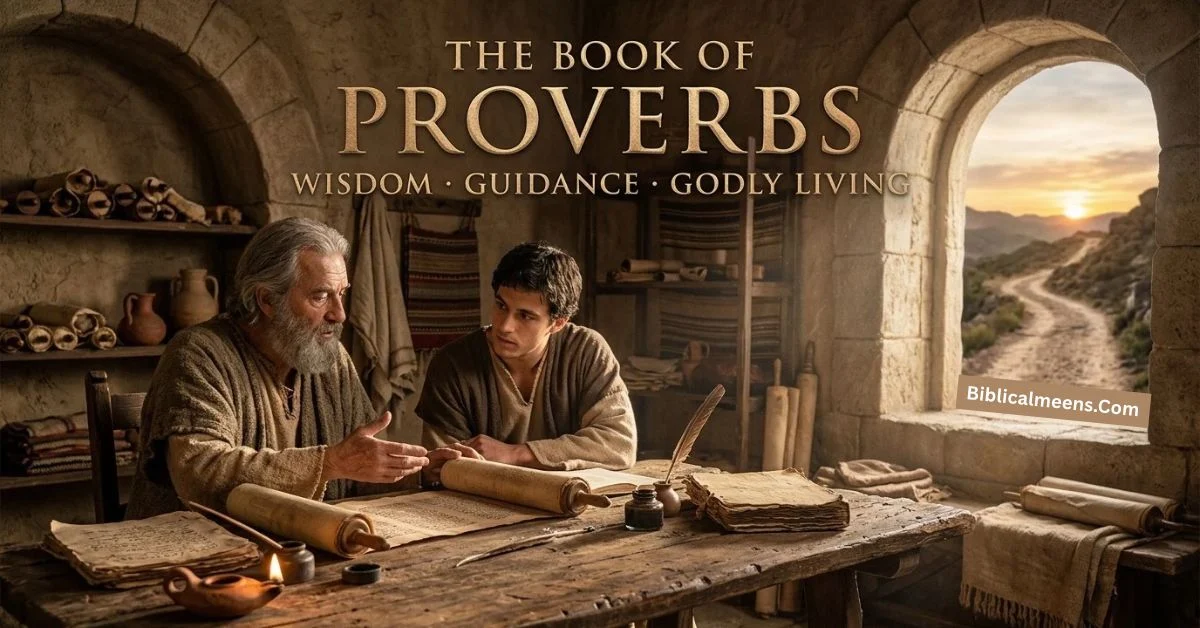
Have you ever opened the Bible because you needed an answer? Maybe you were facing a hard choice, feeling lost, or simply wanted to know how to live in a way that pleases God. For many people, the Book of Proverbs becomes a place of comfort and wisdom during such moments.
When I first read Proverbs, I noticed something special. Its words are simple, but they speak to real life. They talk about wisdom, family, work, money, friendship, words, anger, and faith. Proverbs does not only tell us what to believe. It teaches us how to live.
So, what is the Proverbs meaning in Bible?
In the Bible, Proverbs represents godly wisdom, instruction, understanding, and practical guidance for daily life. It teaches us to fear the Lord, make wise choices, control our words, treat others well, and trust God’s direction.
If you are searching for the spiritual message behind Proverbs, you will find a beautiful lesson here: true wisdom begins with God.
Biblical Meaning of Proverbs in the Bible
The word Proverbs refers to short sayings that teach wisdom and truth. The Book of Proverbs is part of the Old Testament and is strongly connected with King Solomon, although several sections come from other wise writers as well.
The main purpose of Proverbs is clearly stated:
“To know wisdom and instruction; to perceive the words of understanding.” — Proverbs 1:2
This gives us the heart of the book. Proverbs is about learning how to live wisely.
Proverbs Represents Godly Wisdom
One of the strongest meanings of Proverbs is wisdom.
The Bible does not describe wisdom as simply being smart. Biblical wisdom means knowing what is right and choosing to live according to God’s ways.
Proverbs 9:10 says:
“The fear of the LORD is the beginning of wisdom.”
This does not mean being terrified of God. It points to reverence, respect, and honor toward Him.
When we put God first, our choices can become clearer.
Proverbs Represents Instruction
Proverbs also means learning from correction.
Sometimes we do not want to hear that we are wrong. Yet Proverbs teaches that correction can help us grow.
Proverbs 12:1 says that a person who loves instruction also loves knowledge.
This is an important spiritual lesson. Correction is not always rejection. Sometimes it is part of transformation.
If God is showing you an area of your life that needs to change, Proverbs encourages you to listen with humility.
Proverbs Represents Understanding
The Book of Proverbs also teaches us to seek understanding.
Life can feel confusing. We may not know what decision to make, what person to trust, or what direction to take. Proverbs reminds us that we do not have to depend only on our own understanding.
Proverbs 3:5–6 teaches us to trust in the Lord rather than leaning only on ourselves.
This is one of the most comforting messages in Proverbs. God can guide us when we do not see the whole path.
Proverbs Represents Wise Choices
Another important part of the Proverbs meaning in Bible is wise decision-making.
Proverbs often contrasts two paths: the path of wisdom and the path of foolishness.
The wise person listens, learns, thinks before speaking, and seeks God’s ways. The foolish person refuses correction and follows harmful desires.
This does not mean that a wise Christian never makes mistakes. We all do.
Instead, Proverbs teaches us to learn from our mistakes and return to God’s wisdom.
Proverbs Represents the Power of Words
Proverbs gives special attention to speech.
Proverbs 15:1 says:
“A soft answer turneth away wrath.”
Our words can bring peace or create pain. A kind answer can calm an angry situation. A harsh answer can make it worse.
This gives Proverbs a very practical spiritual message: your words matter.
Before speaking, we can ask ourselves:
- Is this true?
- Is this kind?
- Is this helpful?
- Does this honor God?
Proverbs Represents Righteous Living
Proverbs also teaches honesty, kindness, self-control, humility, hard work, and justice.
For example, Proverbs 16:18 warns about pride, while Proverbs 19:17 teaches kindness toward the low-income.
These teachings show that biblical wisdom is not only about personal success. It is also about how we treat other people.
A person can have knowledge but still lack wisdom. Biblical wisdom changes the way we live.
Spiritual Significance and Symbolism of Proverbs
The spiritual symbolism of Proverbs points to a life shaped by God’s wisdom.
When you read Proverbs, you are being invited to slow down and think about your choices. Its teachings can help you grow in faith and become more aware of God’s presence in everyday life.
Proverbs Symbolizes a Path
Proverbs often presents wisdom as a path.
This is a powerful picture because every day we make choices about which path to follow.
You may choose patience instead of anger.
You may choose honesty instead of deception.
You may choose forgiveness instead of bitterness.
You may choose prayer instead of fear.
These small choices can shape your life.
Proverbs Symbolizes Spiritual Growth
Proverbs also points toward transformation.
Godly wisdom is not something we learn once and then forget. It grows as we listen, pray, study Scripture, and experience life.
For example, you may read Proverbs 3:5–6 when you are unsure about your future. Later, you may understand those words in a deeper way because of what you have experienced.
That is part of spiritual growth.
Proverbs Symbolizes Guidance
If Proverbs keeps coming to your mind during a difficult season, you can use it as an invitation to reflect on God’s wisdom.
Rather than looking for a hidden prediction, ask:
“What is God teaching me about the way I live?”
This keeps biblical interpretation grounded in Scripture instead of superstition.
Biblical Interpretations of Proverbs in Dreams or Real Life
Some people may dream about a Bible, Proverbs, writing, books, or words of wisdom. Others may simply feel drawn to read Proverbs during an important season.
The Bible does not give one fixed meaning for dreaming about Proverbs. Dreams should not automatically be treated as divine messages.
Still, the experience may encourage you to think about wisdom, guidance, correction, or spiritual growth.
If Proverbs appears during a peaceful moment, it may remind you to continue walking in God’s wisdom.
If it appears during a stressful season, it may encourage you to slow down, pray, and seek wise counsel.
If you repeatedly feel drawn to Proverbs, consider reading a chapter slowly and asking what lesson applies to your current life.
The safest foundation is always God’s Word, prayer, and wise Christian counsel.
Practical Lessons From Proverbs
The Proverbs meaning in Bible gives us simple lessons for everyday life.
Seek wisdom.
Listen to correction.
Guard your words.
Stay humble.
Treat people with kindness.
Trust God with your decisions.
You do not need to understand everything today. Pray, read Scripture, and take the next wise step.
FAQs About Proverbs Meaning in the Bible
1. What does Proverbs mean in the Bible?
Proverbs means short, wise sayings that teach practical lessons about life, faith, and godly behavior. The Book of Proverbs encourages people to seek wisdom and follow God’s guidance.
2. What is the main message of the Book of Proverbs?
The main message is that true wisdom begins with fearing the Lord. Proverbs teaches honesty, humility, self-control, kindness, and making choices that honor God.
3. What does Proverbs 1:7 mean?
Proverbs 1:7 says, “The fear of the LORD is the beginning of knowledge.” It means that respecting God and recognizing His authority are the foundations of true wisdom.
4. Who wrote the Book of Proverbs?
King Solomon is the primary author associated with Proverbs. However, the book also includes sayings connected to other wise figures, including Agur and King Lemuel.
5. Why is the Book of Proverbs important for Christians?
Proverbs helps Christians apply biblical wisdom to everyday life. Its teachings offer guidance about relationships, work, speech, discipline, decision-making, and spiritual growth.
6. What is the spiritual meaning of Proverbs?
Spiritually, Proverbs encourages believers to develop a closer relationship with God through wisdom, obedience, humility, and understanding. It reminds Christians to seek God’s direction in their daily decisions.
7. What is the most famous verse in Proverbs?
One of the best-known verses is Proverbs 3:5–6, which encourages believers to trust in the Lord rather than relying only on their own understanding and to acknowledge Him in all their ways.
8. How can I apply Proverbs to my daily life?
You can apply Proverbs by speaking truthfully, treating others with kindness, controlling your anger, accepting correction, making thoughtful decisions, and praying for God’s wisdom.
9. Does Proverbs promise success and wealth?
No. Proverbs teaches that wisdom, diligence, and integrity are valuable, but it does not guarantee that every faithful person will become wealthy or avoid hardship.
10. What does “the fear of the Lord” mean in Proverbs?
It means having deep respect, reverence, and awe for God. This attitude encourages believers to follow His teachings, turn away from evil, and seek His wisdom.
Conclusion
The meaning of Proverbs in the Bible goes beyond simple advice. It teaches us to seek God’s wisdom, practice humility, speak with kindness, and make choices that reflect our faith.
Through its practical lessons, the Book of Proverbs reminds Christians that true understanding begins with reverence for the Lord.
Its teachings can guide our relationships, decisions, and daily actions. Whether you are facing challenges or looking for spiritual growth, Proverbs offers valuable direction for living a faithful life.
By reading these scriptures, praying for understanding, and applying their lessons, you can grow in wisdom and strengthen your walk with God.