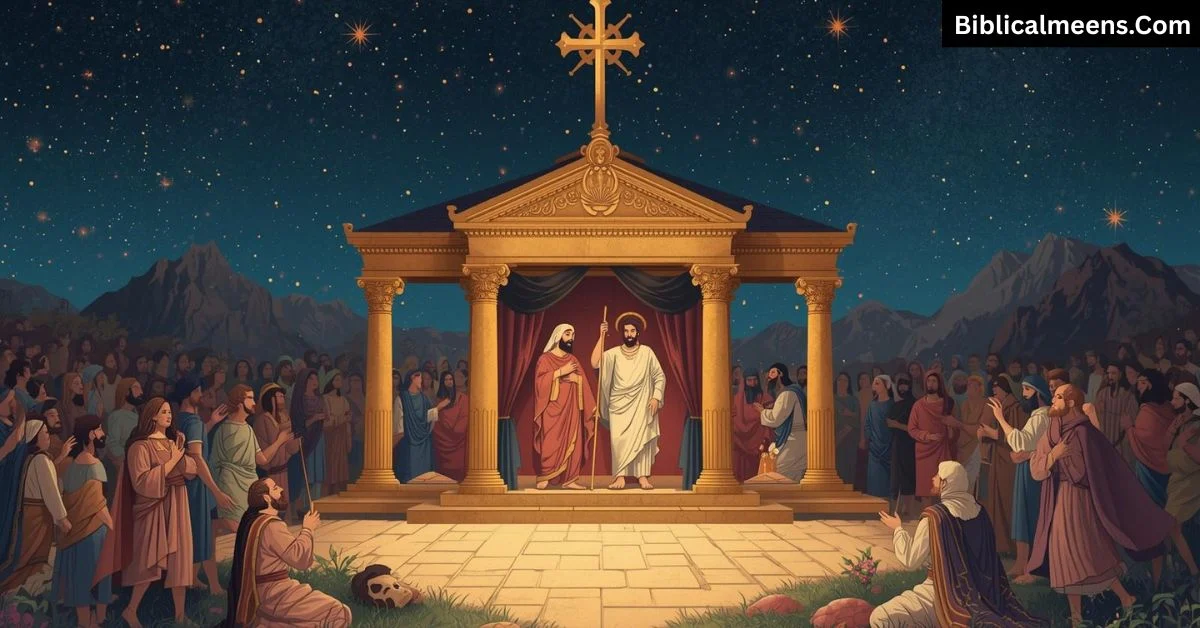
I remember the first time I came across the word tabernacle in the Bible. I paused. It sounded important… but also distant. Like something from a time I couldn’t fully reach.
I asked myself, Is this just an old tent? A place? Or does it mean something deeper?
Maybe you’re here because you felt the same way. You saw the word and wondered, Why does this matter to me today? Or maybe you felt a quiet pull, like there’s something hidden inside that word—something worth understanding.
I’ve been there too. And the more I sat with it, the more I realized: the tabernacle isn’t just a structure from the past. It tells a story about closeness, about presence… about us.
Let’s walk through it together, simply and honestly.
What Does Tabernacle Meaning in Bible Represent?
At its most basic level, the tabernacle in the Bible was a portable tent where God’s presence stayed among His people.
It wasn’t a palace and it wasn’t permanent. It moved as the people moved.
That matters.
The tabernacle represents God choosing to be close, not far away. It shows that He didn’t wait for perfect buildings or perfect people. He came near, right in the middle of their journey.
So when you think of the tabernacle, think of this:
- A place of meeting
- A sign of closeness
- A reminder that God stays with people, even in uncertain times
It’s simple, but powerful.
Core Meaning Explained Clearly
Let’s strip it down even more.
The tabernacle means:
“God lives among His people.”
That’s it.
It wasn’t about gold or curtains or rituals alone. Those were just parts of it. The real meaning was about relationship.
Instead of being distant or unreachable, God chose to dwell right there—among ordinary people with struggles, fears, and questions.
And honestly, that changes how we see everything.
Because if God chose to be near then… it speaks about His nature now too.
Spiritual Meaning
Spiritually, the tabernacle points to something steady and comforting:
You are not alone.
It reflects:
- Protection – God’s presence wasn’t random. It was intentional.
- Guidance – The tabernacle moved when the people moved. It showed direction.
- Awareness – It reminded people to stay mindful of something bigger than themselves.
This isn’t about fear or pressure. It’s about quiet reassurance.
The tabernacle says:
Even in the middle of change, there is a steady presence with you.
Emotional Meaning
Emotionally, the tabernacle connects to feelings many of us carry:
- The need to feel safe
- The desire to belong
- The fear of being alone
When life feels unstable, we look for something solid. The tabernacle reflects that human need.
It gently tells us:
You don’t have to figure everything out alone.
That can ease stress. It can soften fear. It can remind you that your journey—messy as it is—is still seen and held.
Psychological Meaning
From a psychological angle, the tabernacle can be seen as a symbol of inner grounding.
Our minds often search for a “center”—a place of stability when everything feels uncertain.
The tabernacle mirrors that inner process:
- It creates a focus point
- It builds a sense of order and meaning
- It offers a mental space where things feel less chaotic
In simple terms, it reflects how the mind tries to stay balanced during stress.
It’s not just about religion. It’s about how humans cope, organize, and find peace.
Life Situation Meaning
In real life, the meaning of the tabernacle can show up in different ways:
Career
When you feel lost or unsure about your path, the tabernacle reminds you that guidance often comes step by step, not all at once.
Relationships
It points to the importance of presence—being there for someone, not just physically, but emotionally.
Decisions
It encourages you to slow down and stay connected to what feels true and steady inside.
Inner Pressure
When everything feels overwhelming, the tabernacle represents a safe inner space where you can pause and breathe.
It’s not about having all the answers. It’s about staying connected through the process.
Does Tabernacle Meaning in Bible Mean Something Bad Will Happen?
No. It does not mean something bad will happen.
There’s no warning, no hidden danger, no negative prediction tied to the tabernacle.
Instead, it symbolizes closeness, support, and guidance.
If anything, it’s one of the more reassuring symbols in the Bible. It reflects presence—not punishment.
So if the word ever made you uneasy, you can let that go.
Is This a Good or Bad Sign?
The tabernacle is a good and positive sign.
It leans strongly toward:
- Comfort
- Connection
- Stability
It doesn’t carry fear-based meaning. It’s neutral to positive, often encouraging you to stay grounded and aware.
Repeated Experience Meaning
If you keep noticing or thinking about the tabernacle, it may reflect something deeper inside you.
Usually, repetition connects to:
- A need for clarity
- A search for peace
- Unresolved stress or questions
Your mind may be gently pointing you toward something:
Slow down. Stay present. Pay attention to what matters.
It’s not random. It’s awareness trying to grow.
Common Variations & Their Meanings
Here are a few ways the idea of the tabernacle might show up and what they can mean:
1. A Bright or Beautiful Tabernacle
This often reflects hope and emotional comfort. You may be feeling a sense of calm returning.
2. A Broken or Damaged Tabernacle
This can connect to feeling disconnected or overwhelmed. Not as a warning—just a reflection of inner stress.
3. Entering the Tabernacle
This suggests a desire for closeness, understanding, or peace.
4. A Moving Tabernacle
This represents change in your life. It shows that guidance can move with you.
5. An Empty Tabernacle
This may reflect feeling distant or unsure, like something important is missing emotionally.
Each variation connects more to your inner state than any external event.
What Should You Do After This Experience?
You don’t need rituals or complicated steps.
Keep it simple:
- Pause for a moment – let your mind settle
- Reflect gently – ask yourself what you’ve been feeling lately
- Stay present – focus on what’s in front of you right now
- Connect – whether through prayer, journaling, or quiet thought
There’s no pressure to “fix” anything.
Sometimes, awareness itself is enough.
Myths vs Truth
Myth: The tabernacle is just an old religious object
Truth: It represents a living idea—closeness and presence.
Myth: It has hidden or mysterious meanings
Truth: Its message is simple and clear.
Myth: It predicts future events
Truth: It reflects inner awareness, not future outcomes.
Myth: It only mattered in ancient times
Truth: Its meaning still connects deeply to modern life.
Why This Experience Feels So Real
When something like this stands out to you, it can feel intense or meaningful.
That’s because your mind is very good at:
- Connecting symbols with emotions
- Highlighting things that matter to you
- Searching for meaning during uncertainty
The tabernacle feels real because it touches something human:
The need to feel close, safe, and guided.
It’s not strange. It’s natural.
FAQs :
What is the tabernacle in the Bible in simple words?
It is a portable tent where God’s presence stayed among His people.
Why is the tabernacle important?
It shows that God chose to be close to people, not distant.
Does the tabernacle still matter today?
Yes, because its meaning—presence and connection—still applies to life now.
Is the tabernacle a symbol of protection?
Yes, it reflects safety, guidance, and care.
What does the tabernacle teach us?
It teaches that you are not alone, even during uncertain times.
Is the tabernacle a positive symbol?
Yes, it is generally comforting and reassuring.
Why do I keep thinking about the tabernacle?
It may reflect a need for peace, clarity, or emotional grounding.
Does the tabernacle predict the future?
No, it does not predict events. It reflects meaning and awareness.
Conclusion :
When I first tried to understand the tabernacle, I thought I needed deep knowledge or perfect clarity.
But over time, I realized something simpler.
The tabernacle is about presence.
Not perfect conditions. Not perfect people. Just presence.
And maybe that’s what you needed to hear too.
You don’t have to have everything figured out. You don’t have to be certain about every step.
Sometimes, the most important thing is knowing that you’re not walking alone—even when it feels that way.
That quiet reassurance… that steady sense of being held… that’s what the tabernacle points to.
And that’s something you can carry with you, wherever you go.