Have you ever received a text calling you a “brat” and wondered whether it was an insult, a joke, or even a little bit of flirting? You are not alone. The word brat has become popular in online conversations, social media posts, memes, and dating apps. Its meaning can change depending on who says it, how they say it, and the situation.
In everyday language, a brat usually describes someone who acts spoiled, stubborn, demanding, or playfully difficult. However, modern internet culture has given the word a broader meaning. Friends may use it to tease each other, couples may use it flirtatiously, and social media users may embrace it as a bold, confident personality style.
Understanding the context is the easiest way to figure out what someone means. In this guide, we will explore the brat meaning slang, its origins, how people use it on WhatsApp, Instagram, and TikTok, and how to respond when someone calls you one.
1. Brat Meaning Slang: Definition and Explanation
The slang word brat generally refers to someone who behaves in a spoiled, cheeky, stubborn, or mischievous way. Traditionally, the word has a negative meaning because it describes someone who expects special treatment or refuses to behave appropriately.
For example, imagine a friend who insists on choosing the restaurant, complains when things do not go their way, and refuses to compromise. Someone might jokingly call that friend a brat.
However, the word is not always meant to hurt someone’s feelings. In casual conversations, it can be playful, affectionate, or even flirtatious.
Common meanings of brat
- Spoiled person: Someone who expects others to give them whatever they want.
- Playfully stubborn person: Someone who enjoys teasing others or being difficult in a harmless way.
- Cheeky personality: A person who acts bold, mischievous, or slightly rebellious.
- Flirty personality: Someone who enjoys playful challenges, teasing, or a little attitude in a romantic interaction.
- Confident, rebellious style: In modern pop culture, brat can describe someone who embraces an imperfect, unapologetic, and independent attitude.
Examples of brat in sentences
Here are some examples that show how the meaning changes with context.
Example 1: “Stop acting like a brat!”
Meaning: The speaker thinks someone is behaving immaturely or selfishly.
Example 2: “You’re such a brat 😂”
Meaning: The speaker may be teasing a friend in a playful way.
Example 3: “I can be a little brat sometimes.”
Meaning: The person is admitting that they can be stubborn, cheeky, or difficult.
Example 4: “She’s got that brat energy.”
Meaning: She has a bold, mischievous, rebellious, or unapologetic personality.
The most important thing to remember is that brat does not always mean spoiled or rude. Tone, relationship, and context determine whether it is criticism, friendly teasing, or a compliment.
2. Background: Where Did Brat Come From?
The word brat existed long before texting and social media became popular. Its traditional use described a child, especially one considered badly behaved or spoiled. Over time, people began using it for adults who acted selfishly, stubbornly, or immaturely.
For many years, calling someone a brat was usually an insult. Parents might use the word to criticize a child’s behavior, while friends might use it when someone was being unreasonable.
Internet culture gradually expanded the word’s meaning. Like many slang terms, brat became more flexible as people started using it in jokes, memes, captions, and conversations about personality.
The influence of pop culture
A major modern influence was Charli XCX’s 2024 album Brat. The album helped popularize a distinctive aesthetic associated with bold self-expression, messy confidence, nightlife, and rejecting the pressure to appear perfect.
The related term brat summer became widely associated with embracing an unapologetic, rebellious, and carefree attitude.
In this context, being a brat does not necessarily mean behaving like a spoiled child. It can mean being confident, expressive, unconventional, and comfortable with imperfections.
How the meaning has changed
The evolution of the word can be understood in three stages:
- Traditional meaning: A spoiled or badly behaved child.
- Casual slang: A stubborn, cheeky, or mischievous person.
- Modern pop culture: Someone who embraces a bold, rebellious, imperfect, and confident identity.
These meanings can overlap, but they are not interchangeable in every situation. Calling someone a brat during an argument may sound insulting, while describing an outfit or social media aesthetic as brat may suggest a fashionable, rebellious vibe.
Understanding this background helps explain why the word appears in so many different online conversations today.
3. How Brat Is Used in Different Contexts
The meaning of brat depends heavily on the situation. The same word can express annoyance, affection, humor, or confidence.
In everyday conversations
People commonly use brat to describe someone who is acting stubborn or demanding.
Example: “He became a brat when he didn’t get his way.”
Here, the word criticizes his behavior.
Among friends
Friends often use brat as a lighthearted tease.
Example: “You’re such a brat for stealing my fries!”
The speaker is probably joking rather than seriously insulting the other person.
On social media
The word can describe a person’s personality, fashion, music preferences, or overall aesthetic.
Example: “This outfit is giving brat energy.”
This usually suggests a bold, edgy, rebellious, or playful style.
In professional settings
Brat is not generally a professional term. Calling a coworker or client a brat can sound disrespectful, even if the speaker intends it as a joke.
Instead of saying, “He’s acting like a brat,” a professional might say, “He’s being unreasonable” or “He’s having difficulty accepting feedback.”
In parenting and family conversations
Parents may use brat to describe behavior they consider selfish or disrespectful. However, the word labels the person rather than identifying the specific behavior.
A more constructive alternative is to explain what needs to change, such as sharing, listening, or accepting boundaries.
The key lesson is that brat is informal slang, and its tone depends on the relationship between the people involved. It is safest to avoid using it in formal or unfamiliar situations.
4. Brat Meaning in Chat, WhatsApp, Instagram, and TikTok
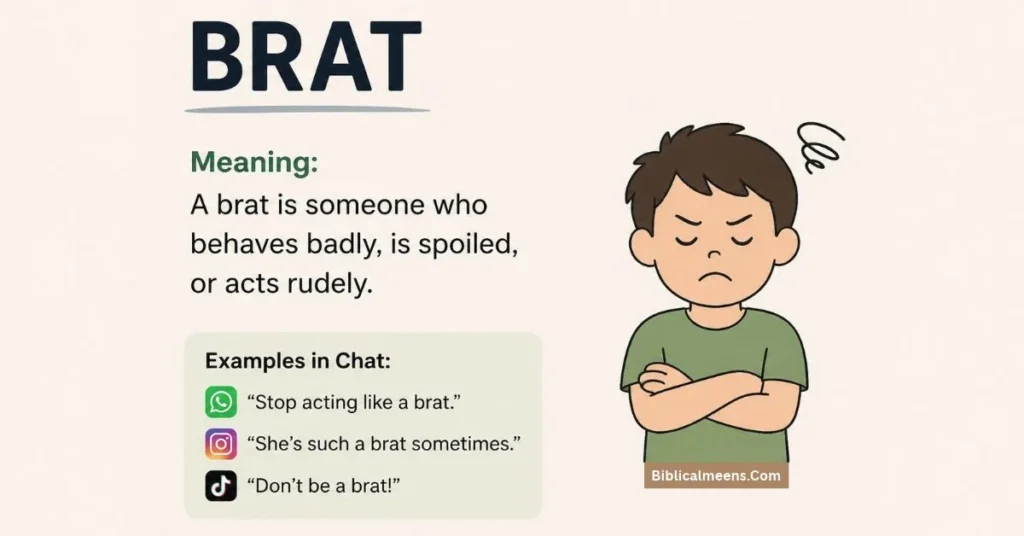
Online, brat can communicate a lot with just a few words. Emojis, punctuation, and the surrounding message often help clarify the intended meaning.
Brat meaning in chat
In text messages, brat usually describes someone who is being cheeky, stubborn, spoiled, or playfully difficult.
Example:
Friend: “You never let me pick the movie.”
You: “Because you have terrible taste 😂”
Friend: “You’re such a brat!”
In this exchange, brat is likely friendly teasing.
Brat meaning on WhatsApp
On WhatsApp, the word can appear in private chats, group conversations, and status updates.
Examples:
- “My little brat ❤️” — An affectionate nickname.
- “Don’t be a brat today 😂” — A playful warning.
- “Fine, I’ll be a brat then 🙄” — A cheeky or stubborn response.
The relationship between the people matters. A message from a close friend may sound affectionate, while the same message from someone unfamiliar may feel rude.
Brat meaning on Instagram
Instagram users may use brat in captions, comments, outfit descriptions, and aesthetic-related posts.
Examples include “brat energy,” “brat girl,” and “brat summer.”
These expressions can refer to confidence, rebellious fashion, playful attitude, or a particular pop-culture-inspired look.
Brat meaning on TikTok
On TikTok, brat often appears in videos about personality, humor, fashion, music, and lifestyle.
A creator describing themselves as a brat may be joking about being demanding or stubborn. Alternatively, they may be embracing a bold, imperfect, and rebellious aesthetic.
For example, a video featuring bright green visuals, confident styling, and an unapologetic attitude might use brat to describe its overall vibe.
Quick answer: In online conversations, brat usually means spoiled, cheeky, stubborn, or playfully rebellious. On social media, it can also refer to a confident pop-culture aesthetic.
5. Brat Meaning in Physics, Medical, and Aircraft Terminology
Although brat is widely used as slang, it is not a standard technical term with one universal meaning in physics, medicine, or aviation. If you encounter the word in one of these fields, the surrounding text matters.
Brat meaning in physics
Brat is not a commonly recognized standalone physics term. If it appears in a physics textbook, research paper, or classroom discussion, it may be part of a variable name, an abbreviation defined by the author, or a typo.
For example, a phrase containing the letters “BRAT” in a technical document should not automatically be interpreted as slang. Check the document’s definitions and surrounding equations.
Brat meaning in medical terminology
Brat is not a standard medical diagnosis or universally recognized medical abbreviation.
You may encounter BRAT diet, a familiar acronym for bananas, rice, applesauce, and toast. This bland-food approach has historically been discussed in connection with digestive upset, particularly diarrhea.
However, the BRAT diet is restrictive and does not provide complete nutrition. It is not generally recommended as the sole diet for an extended period. Hydration and appropriate nutrition are important during recovery, and medical advice may be needed depending on the symptoms.
Here, BRAT is an acronym rather than the slang word describing someone’s personality.
Brat meaning in aircraft terminology
Brat is not a widely established, universal aviation term. In an aircraft manual, pilot communication, or technical report, it could be a locally defined abbreviation, a name, or a typographical error.
Always consult the specific manual, glossary, or official aviation documentation before assigning a technical meaning.
The main distinction is simple: brat has a familiar informal meaning in everyday English, but technical uses require field-specific context.
6. Common Misconceptions About Brat Slang
Several misunderstandings can make online conversations confusing.
Misconception 1: Brat is always an insult
Not necessarily. It can be affectionate teasing between friends, family members, or romantic partners. However, it can still be insulting when used to criticize someone’s behavior.
Misconception 2: Brat always means childish
The traditional meaning often involves childish or spoiled behavior, but modern pop culture also uses brat to describe confidence, rebellion, and self-expression.
Misconception 3: Brat is always flirtatious
Some people use it while flirting, but others use it casually or critically. The word alone does not prove romantic interest.
Misconception 4: Brat and brat summer mean exactly the same thing
Brat summer is a specific pop-culture expression associated with an aesthetic and attitude. Calling someone a brat can simply mean that they are being stubborn or demanding.
Misconception 5: Calling yourself a brat means you are genuinely spoiled
Not always. Someone may use the label humorously, ironically, or as part of an online identity. Their behavior provides more information than the label itself.
To avoid misunderstandings, pay attention to the speaker’s tone, your relationship, the topic, and any emojis or surrounding messages.
7. Similar Terms and Alternatives to Brat
Several English words overlap with brat, but each has a slightly different meaning.
| Word | Meaning | Typical tone |
|---|---|---|
| Spoiled | Used to getting what you want | Usually negative |
| Cheeky | Bold or playfully disrespectful | Often playful |
| Sassy | Confident, sharp, or outspoken | Playful or positive |
| Mischievous | Enjoying harmless trouble or tricks | Usually playful |
| Rebellious | Resisting rules or expectations | Neutral or positive |
| Diva | Someone demanding or acting important | Often teasing or negative |
| Trouble-maker | Someone who causes problems | Usually negative |
| Bratty | Behaving in a spoiled or cheeky way | Context-dependent |
Which word should you use?
Choose cheeky when someone is playfully bold. Use sassy when a person responds with confidence or attitude. Choose spoiled when you specifically mean that someone expects special treatment.
If you want to describe the modern pop-culture aesthetic, expressions such as “bold,” “unapologetic,” and “rebellious” may communicate the idea more clearly.
These alternatives help you express your meaning without accidentally offending someone.
8. How to Respond When Someone Calls You a Brat
Your response should depend on whether the person is joking, flirting, or criticizing you.
If a friend is teasing you
You can respond with humor:
- “Only a little 😂”
- “You love it!”
- “Guilty as charged!”
- “I’m just keeping things interesting.”
These replies keep the conversation light.
If someone is flirting
If you are comfortable with the playful tone, try:
- “Maybe you bring it out of me 😉”
- “And what are you going to do about it?”
- “You seem to enjoy my attitude.”
Use these responses only when the interaction feels welcome and appropriate.
If someone is criticizing you
A calm response can help avoid unnecessary conflict:
- “What makes you say that?”
- “I wasn’t trying to be difficult.”
- “Let’s talk about what bothered you.”
- “I understand you’re upset, but please explain the issue without insulting me.”
You do not have to accept a label just because someone uses it.
If you are unsure what they mean
The simplest option is to ask, “Do you mean that jokingly or seriously?”
This gives the other person an opportunity to explain their intention. Remember that your comfort matters, and playful language should not become an excuse for disrespect.
9. Brat vs. Similar Words: What Is the Difference?
Brat is often confused with words such as sassy, spoiled, and naughty. Although they can overlap, their meanings are different.
Brat vs. spoiled: A spoiled person expects special treatment, while a brat may simply be acting stubborn or cheeky in a particular moment.
Brat vs. sassy: A sassy person is bold and outspoken. A brat is more closely associated with demanding, mischievous, or difficult behavior, although modern slang can make the meanings overlap.
Brat vs. naughty: Naughty usually describes behavior that breaks rules or is considered improper. Brat more often describes the person or their attitude.
Brat vs. rebellious: Rebellious means resisting authority or social expectations. It can be positive or negative, depending on the circumstances, whereas brat traditionally carries a more childish or demanding implication.
Brat vs. bratty: Brat is a noun describing a person, while bratty is an adjective describing behavior.
For example, “He’s a brat” labels the person, while “He’s acting bratty” describes how he is behaving.
Understanding these differences helps you interpret slang more accurately and choose the right word for the situation.
10. Brat Meaning in Online Conversations and Dating Apps
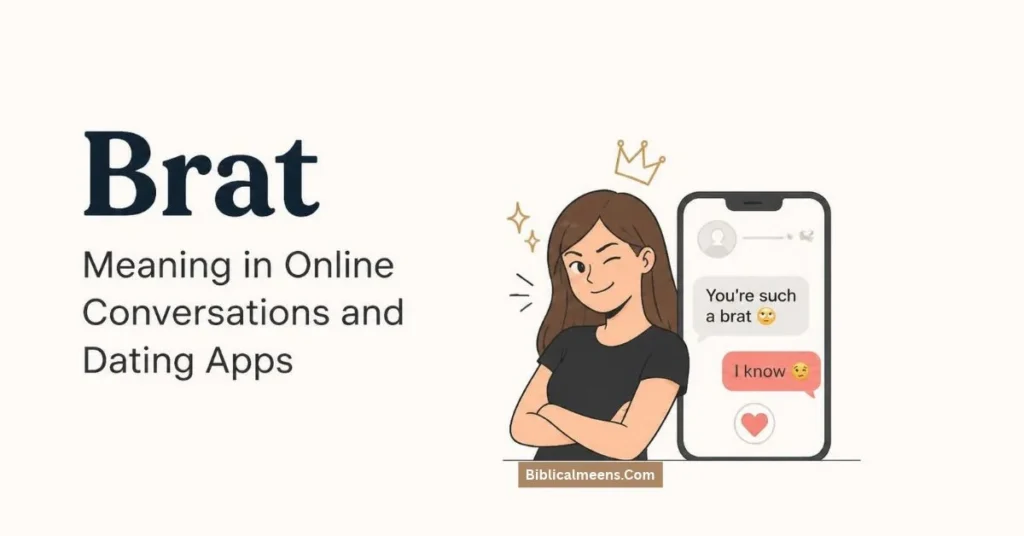
On dating apps and in romantic conversations, brat can carry a playful or flirtatious meaning. Someone might use it to describe a person who enjoys teasing, challenging, or playfully pushing boundaries.
For example:
Person A: “You always have to get the last word, don’t you?”
Person B: “Maybe I’m a little bratty 😉”
This exchange suggests playful banter, but it does not automatically mean the people are romantically interested in each other.
In some dating and relationship communities, brat can also refer to a consensual role or dynamic in which someone playfully challenges their partner. This is a more specific meaning and should not be assumed from an ordinary text message.
How can you tell what it means on a dating app?
Look at the wider conversation:
- Playful emojis: A wink or laughing emoji may suggest teasing.
- Personal compliments: The word may be part of flirtatious banter.
- Critical comments: It may be a negative judgment about someone’s behavior.
- Explicit relationship context: A more specialized meaning may be intended if both people have discussed it openly.
Most importantly, do not assume that using the word brat signals consent, attraction, or a particular relationship preference. If the meaning matters, ask rather than guessing.
In online dating, the best conversations are those in which both people feel comfortable expressing their intentions and boundaries.
Conclusion
The brat meaning slang can vary from a negative description of a spoiled or demanding person to a playful nickname between friends. In texting, WhatsApp chats, and dating apps, it may express teasing, affection, or flirtation. On Instagram and TikTok, it can also describe a bold, rebellious, and unapologetic aesthetic influenced by modern pop culture.
The most important factor is context. A friend calling you a brat with a laughing emoji may be joking, while someone using the word during an argument may be criticizing your behavior. The word also has a separate meaning in the acronym BRAT diet, showing why context matters beyond slang.
When you encounter this expression, consider the relationship, tone, and surrounding conversation before deciding what it means. If you are unsure, asking for clarification is always a reasonable choice. Understanding the different meanings of brat helps you communicate confidently and avoid unnecessary misunderstandings online.