Have you ever come across the word elfin in a book, social media post, romantic message, or online conversation and wondered what it means?
This unusual word can sound magical, playful, or even mysterious. Its meaning depends on the context in which it appears.
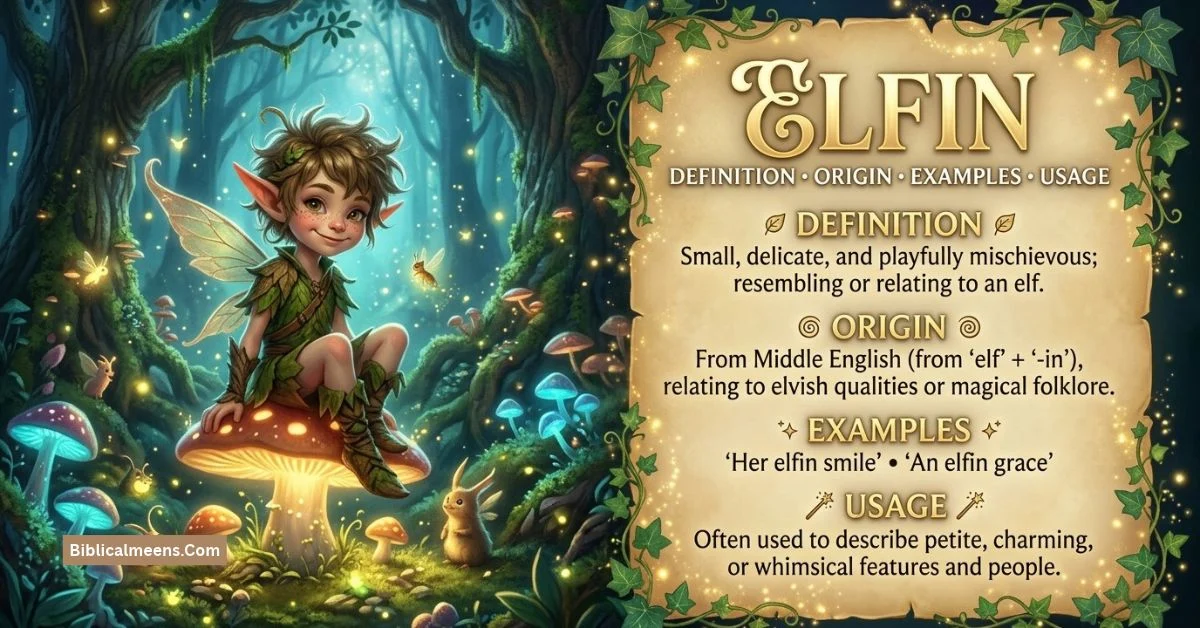
The word elfin generally describes someone or something that resembles an elf, a small mythical creature often associated with magic, fantasy, and folklore.
When used to describe a person, it often suggests delicate features, a small build, a youthful appearance, or a charming and mischievous personality.
People search for the meaning of this word because they may have seen it in a novel, heard it as a description of someone’s appearance, or encountered it in a social media caption. Others may want to understand whether it is a compliment, a nickname, or a term used in casual conversation.
In this guide, you will learn the definition, background, common uses, related terms, and possible meanings of elfin in different contexts.
1. Meaning and Definition of Elfin
Elfin means resembling an elf or having the small, delicate, magical, or mischievous qualities traditionally associated with elves.
The word is an adjective, which means it describes a person, object, appearance, or quality. It is commonly found in literature, fantasy stories, and descriptions of people with distinctive features.
For example, someone might describe a person as having an elfin face because their features appear small, delicate, or unusually youthful.
Common meanings
The word can communicate several related ideas:
- Elf-like appearance: Small, pointed, or delicate facial features.
- Youthful charm: A fresh, innocent, or childlike appearance.
- Magical quality: An appearance that seems enchanting or otherworldly.
- Mischievous personality: A playful, lively, or slightly naughty manner.
- Fantasy association: Something connected with elves, fairy tales, or imaginary worlds.
The exact meaning depends on the sentence. An elfin smile might suggest playfulness, while an elfin figure might describe a small, graceful person.
Examples of elfin in sentences
Here are some simple examples:
- “She had an elfin face and bright, curious eyes.”
- “His elfin smile made everyone laugh.”
- “The artist created an elfin character for the fantasy story.”
- “The garden looked magical, with tiny elfin statues hidden among the flowers.”
In each example, the word adds a sense of delicacy, fantasy, or playful charm.
It is important to remember that elfin does not automatically mean short, childish, or supernatural. It is a descriptive word, and its meaning changes slightly according to what it describes.
2. Background and Origin of the Word
The word elfin comes from the word elf, which refers to a mythical being found in European folklore and traditional stories.
Elves have been portrayed in different ways throughout history. In some traditions, they are mysterious supernatural beings connected with nature. In modern fantasy, they are often imagined as graceful, magical, long-lived, or human-like creatures with distinctive features.
The adjective elfin developed to describe something that resembles these beings or reflects qualities associated with them.
Over time, writers began using the word beyond descriptions of mythical creatures. It became a way to describe real people, especially those with delicate facial features, a small frame, or a playful appearance.
For instance, a writer might describe a character as having an elfin appearance to create an image of someone who seems unusual, charming, or almost magical.
Elfin in literature and fantasy
The word is particularly useful in imaginative writing because it creates a strong visual impression without requiring a long description.
A phrase such as “an elfin figure” may suggest someone small, graceful, and mysterious. Similarly, an “elfin expression” can imply a combination of innocence and mischief.
Fantasy novels, fairy tales, poetry, and character descriptions often benefit from words like this because they help establish atmosphere.
Is elfin an old-fashioned word?
Although it has literary associations, elfin is still understandable in modern English. However, it is not as common in everyday conversation as words such as cute, playful, delicate, or youthful.
People may encounter it more frequently in books, artistic descriptions, fantasy communities, and discussions of character design.
Its continued use reflects the lasting influence of folklore and fantasy on the English language.
3. Usage in Different Contexts
The meaning of elfin can shift depending on the subject being described. Although the central idea remains elf-like qualities, the word can create different impressions in different settings.
In everyday English
In everyday writing, it usually describes someone’s appearance or personality.
Example: “Her elfin features gave her a distinctive look.”
This suggests that her features are delicate or reminiscent of an elf.
In books and creative writing
Authors use the word to make characters seem graceful, unusual, magical, or playful.
Example: “An elfin stranger appeared beneath the moonlight.”
This sentence creates a fantasy atmosphere without explicitly explaining whether the stranger is actually an elf.
In fashion and beauty
The term can describe delicate facial features, a small frame, or a distinctive appearance.
Example: “The model had an elfin beauty that stood out from traditional fashion styles.”
Here, it communicates a particular aesthetic rather than a literal connection to mythical creatures.
In gaming and fantasy communities
In fantasy games, elfin may describe a character, costume, hairstyle, or design inspired by elves.
Example: “I’m creating an elfin character for my next role-playing game.”
The term helps communicate a fantasy-inspired look or identity.
In professional writing
The word may appear in publishing, art, fashion, entertainment, or creative design. It is less common in technical or formal business communication.
For example, a designer might describe a fictional character’s appearance as elfin when explaining the visual direction of an animation.
In most professional settings, the word is descriptive rather than technical. It does not have a single specialized meaning across all industries.
4. Elfin Meaning in Chat, WhatsApp, Instagram, and TikTok
When someone uses elfin in a message or social media caption, they are usually describing an appearance, mood, or fantasy-inspired style. It is not a widely established texting abbreviation.
Unlike common internet expressions such as LOL or BRB, the word does not normally stand for a longer phrase.
Meaning in chat
In a private message, someone might use the word to compliment another person’s appearance or describe a character.
Example:
Person A: “What do you think of my new photos?”
Person B: “You have such an elfin look!”
This is likely a compliment suggesting that the person looks delicate, charming, or slightly magical.
Meaning on WhatsApp
On WhatsApp, the word may appear in a personal message, contact nickname, or conversation about someone’s appearance.
Example: “Your little smile looks so elfin in that picture.”
The sender probably means that the smile looks playful or charming.
Meaning on Instagram
On Instagram, elfin may appear in captions about fashion, photography, makeup, fantasy costumes, or artistic portraits.
Example: “An elfin mood for today’s photoshoot.”
This suggests a delicate, whimsical, or fantasy-inspired aesthetic.
Meaning on TikTok
TikTok users interested in fantasy fashion, cosplay, character transformations, or creative makeup may use the word to describe a particular look.
Example: “Trying an elfin makeup style today.”
This suggests makeup inspired by the appearance of elves, perhaps featuring delicate details, pointed-ear accessories, or an ethereal aesthetic.
Important: The meaning is not fixed across social media. The surrounding text, images, and tone help determine what the sender intends.
5. Elfin Meaning in Physics, Medical, and Aircraft Terminology
The word elfin is primarily a general English adjective rather than a standard technical term in physics, medicine, or aviation.
Understanding this distinction can help prevent confusion when the word appears in a specialized discussion.
Elfin in physics
In physics, elfin does not have one widely recognized, standard meaning comparable to terms such as gravity, velocity, or electrical resistance.
If it appears in a physics-related article, it may be part of a product name, fictional example, project title, or informal description. The surrounding material is necessary to identify its intended meaning.
Elfin in medical terminology
In medical writing, elfin is not a general diagnostic term for a disease or condition. However, the related expression elfin facies has been used in medical literature to describe a particular facial appearance associated with certain conditions.
This expression is historically associated with Williams syndrome, a genetic condition that can involve distinctive facial features and other developmental or medical characteristics.
The term should be understood carefully because appearance alone cannot establish a diagnosis. Medical assessment requires appropriate clinical evaluation, not simply a descriptive label.
Elfin in aircraft terminology
In aviation, elfin is not a standard general term for an aircraft component, flight maneuver, or aerodynamic principle.
If you encounter it in an aircraft manual, aviation forum, or technical document, it may refer to a specific name, designation, or context-dependent expression.
It is best to check the complete sentence and the source rather than assume it has a technical definition.
Overall, the ordinary meaning of elfin remains related to elf-like qualities. Specialized contexts may use the word differently, so technical interpretations should be based on reliable subject-specific information.
6. Common Misconceptions About Elfin
Several misunderstandings can arise when people encounter this word for the first time.
Misconception 1: Elfin always means short
Not necessarily. Although the word can suggest a small or delicate appearance, it may also describe facial features, a smile, or a playful expression.
Misconception 2: Elfin means someone is literally an elf
No. When used about a real person, it is usually figurative. The speaker is describing a resemblance or quality, not claiming that the person belongs to a mythical species.
Misconception 3: Elfin is a texting abbreviation
It is not generally used as an acronym or standard texting abbreviation. It is an ordinary English adjective that can appear in online messages.
Misconception 4: Elfin is always a compliment
It is often positive, especially when used to describe someone’s charm or appearance. However, the intention depends on tone and context. Some people may not appreciate being described as childlike or unusually delicate.
Misconception 5: Elfin and elf are interchangeable
The two words are related but perform different grammatical roles. Elf is generally a noun, while elfin is an adjective.
Understanding these distinctions makes it easier to interpret the word correctly in conversation and writing.
7. Similar Terms and Alternatives
Several English words share some of the qualities associated with elfin, but each has its own meaning.
- Elf-like: Closely resembling an elf. This is a direct and easy-to-understand alternative.
- Ethereal: Extremely delicate, light, or seemingly otherworldly.
- Whimsical: Playful, imaginative, or unusual.
- Delicate: Fine, gentle, or subtle in appearance.
- Pixie-like: Resembling a pixie, often suggesting a small, lively, mischievous appearance.
- Youthful: Looking young or displaying the energy associated with youth.
- Fairylike: Resembling a fairy or suggesting a magical quality.
- Petite: Small and delicately built, especially when describing a person.
For example, “an elfin smile” may suggest a magical or mischievous quality, while “a youthful smile” focuses more on age or freshness.
Similarly, “an ethereal dress” suggests a light, dreamy appearance, whereas “an elfin dress” might imply a fantasy-inspired design.
The best alternative depends on whether you want to emphasize appearance, personality, size, or a magical atmosphere.
8. How to Respond When Someone Calls You Elfin
If someone calls you elfin, the best response depends on the situation and how the word makes you feel.
Because the word is often complimentary, a simple thank-you is usually appropriate.
If it is a compliment
You could reply:
- “Thank you! That’s a lovely compliment.”
- “I’ve never heard that description before!”
- “That’s such a unique way to describe me.”
If the person is talking about your style
You might say:
- “I’m glad you like the look!”
- “I was going for something a little magical.”
- “Thanks! I love fantasy-inspired styles.”
If you do not understand the word
It is perfectly fine to ask for clarification.
For example: “Thanks! What do you mean by elfin?”
This lets the other person explain what they intended without creating unnecessary confusion.
If you dislike the description
You can politely express your preference.
For example: “I know you mean well, but I’d prefer a different description.”
You do not have to accept every label simply because someone intends it positively. The important thing is to respond naturally and consider the context.
9. Differences Between Elfin and Similar Words
Although elfin overlaps with words such as pixie-like, petite, and ethereal, they are not identical.
| Word | Main meaning | Typical impression |
|---|---|---|
| Elfin | Resembling an elf | Magical, delicate, playful |
| Pixie-like | Resembling a pixie | Lively, mischievous, whimsical |
| Petite | Small in physical build | Small, neat, delicate |
| Ethereal | Seemingly otherworldly | Dreamy, light, graceful |
| Youthful | Having a young appearance | Fresh, young, energetic |
| Whimsical | Playfully imaginative | Creative, unusual, charming |
The main difference is that elfin directly connects a description with the traditional image of elves.
For instance, a person may be petite without looking elfin. Someone may have an ethereal appearance without seeming mischievous. A whimsical outfit may be colorful and playful without resembling fantasy clothing.
Choosing the right word helps communicate the exact impression you want to express.
10. Relevance in Online Conversations and Dating Apps
On dating apps, elfin may be used to describe a person’s appearance, profile photographs, or overall aesthetic. It is not a standardized dating abbreviation, so its meaning should be interpreted through the conversation.
For example, someone might write, “You have an elfin smile,” as a way to express attraction or admiration. The phrase may suggest that the person’s smile looks playful, delicate, or distinctive.
In a dating profile, a person might describe their style as elfin to communicate an interest in fantasy fashion, folklore, cosplay, or whimsical photography.
However, the word does not automatically indicate romantic interest. A person might use it simply as an artistic description or friendly compliment.
If someone uses elfin while flirting, consider the other signals in the conversation. Are they asking questions, expressing interest, or trying to continue the discussion? Those details are more informative than one adjective alone.
A natural response could be, “That’s an interesting compliment! What made you choose that word?”
This keeps the conversation friendly and gives the other person a chance to explain their meaning.
Ultimately, elfin can add personality and imagination to online communication. Its value lies in its descriptive quality rather than any hidden or universal dating meaning.
Conclusion
The word elfin describes someone or something that resembles an elf or has qualities associated with elves, such as delicate features, youthful charm, playfulness, or a magical appearance. It is commonly used in literature, fantasy, fashion, creative writing, and social media.
When you encounter it in a chat, WhatsApp message, Instagram caption, TikTok video, or dating conversation, it usually functions as a descriptive adjective rather than an abbreviation. It may be intended as a compliment, but the exact meaning depends on the context and the speaker’s intention.
Although elfin shares similarities with words such as ethereal, petite, and pixie-like, each term communicates a slightly different impression. Understanding these differences helps you use the word naturally and interpret it more confidently.
In simple terms, elfin means elf-like, delicate, playful, or somewhat magical in appearance or character. It is a distinctive English word that brings a touch of fantasy and imagination to everyday descriptions.