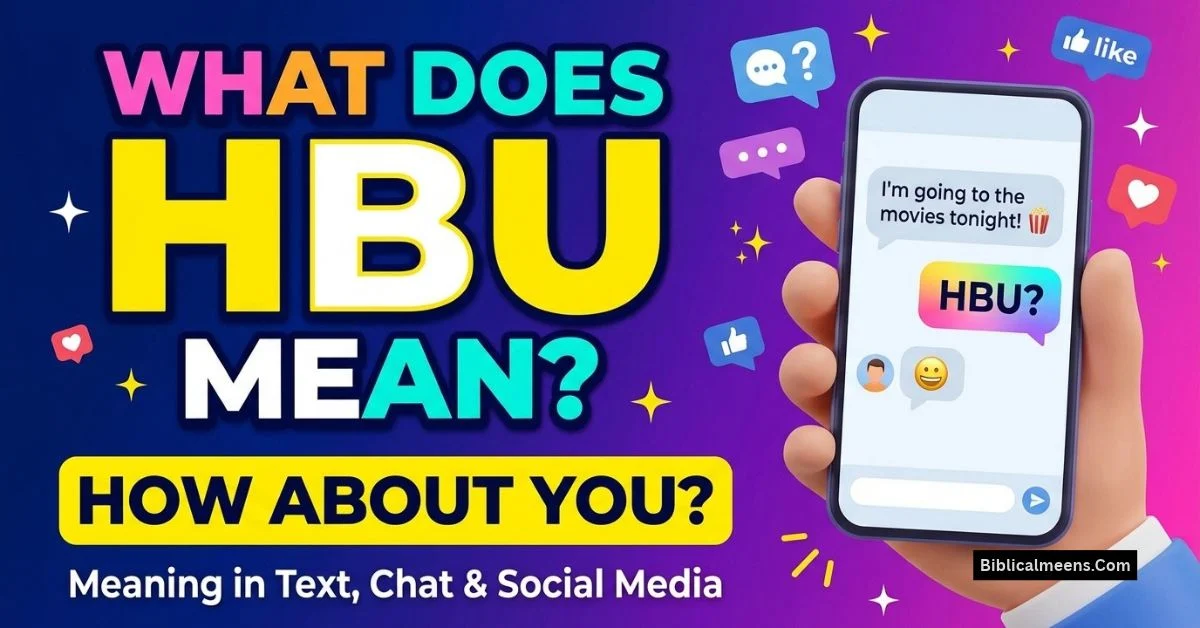
Have you ever received a text that says “HBU?” and wondered what the other person was asking? If you spend time chatting with friends, using social media, or meeting people online, you have probably seen short forms like this.
The HBU meaning is simple: it stands for “How About You?” People use it in text messages to ask about your feelings, opinions, experiences, or plans. It is a quick and friendly way to keep a conversation going without typing a full sentence.
For example, someone might text, “I’m doing great, HBU?” They are telling you how they feel and asking how you feel in return.
You may see HBU on WhatsApp, Instagram, Snapchat, TikTok, and dating apps. It is common in casual conversations because it saves time and makes messages feel natural.
In this guide, you will learn what HBU means, where it comes from, how to use it correctly, and how to respond when someone sends it to you.
1. HBU Meaning and Definition
HBU stands for “How About You?” It is a common texting abbreviation used to return a question or ask someone about their own situation.
Instead of typing the complete phrase, people use HBU to make conversations shorter and faster. It is especially popular in informal digital communication.
For example:
Person A: “I’m feeling good today. HBU?”
Person B: “I’m good too, thanks!”
In this conversation, the first person shares how they feel and then asks the other person the same question.
HBU can be used in many situations, including:
- Feelings: “I’m happy today, HBU?”
- Plans: “I’m staying home tonight. HBU?”
- Interests: “I love watching movies. HBU?”
- Opinions: “I think this song is amazing. HBU?”
- Daily activities: “I’m studying right now. HBU?”
The abbreviation works because the other person can understand the question from the conversation.
HBU is usually friendly and neutral. It does not automatically express romantic interest, anger, or sarcasm. The tone depends on the surrounding words and the relationship between the people chatting.
It is also worth knowing that HBU is different from asking a completely new question. Often, it refers back to something the other person has just discussed.
For example, if a friend asks what you are doing this weekend, you might reply, “I’m going shopping. HBU?” This invites your friend to share their plans, too.
In simple words, HBU means “How about you?” It helps people exchange information and keep conversations balanced.
2. Background and Origin of HBU
HBU developed as part of the broader culture of internet slang and text messaging. As mobile phones and online messaging became popular, people began shortening common phrases to communicate more quickly.
Expressions such as “How about you?” were natural candidates for abbreviation because they appear frequently in everyday conversations. Rather than typing all three words, users could simply write HBU.
The abbreviation became useful in SMS messages, instant messaging, online chat rooms, and later social media direct messages.
Other popular abbreviations developed around the same time or became common in similar settings, including:
- BRB: Be right back.
- LOL: Laughing out loud.
- IDK: I don’t know.
- WYD: What are you doing?
- WBU: What about you?
HBU and WBU are especially similar because both can be used to ask about another person’s situation. In many conversations, they serve nearly the same purpose.
As communication moved from traditional text messages to platforms such as WhatsApp, Instagram, Snapchat, and TikTok, HBU remained useful because it is short, easy to type, and widely understandable.
Unlike some slang expressions that become popular through a particular meme or viral trend, HBU is a straightforward abbreviation of an everyday phrase. Its meaning is not tied to one social media platform or generation.
Today, people use HBU in casual conversations with friends, classmates, relatives, and online acquaintances. Some users write it in capital letters, while others prefer lowercase “hbu.” Both forms generally communicate the same thing.
3. HBU Usage in Different Contexts
HBU is flexible because “How about you?” can fit many everyday situations. The exact question depends on what the speakers are discussing.
Casual conversations
Friends often use HBU when talking about their day, feelings, hobbies, or weekend plans.
Example:
“I’m going to watch a movie tonight, HBU?”
This asks the other person what they plan to do.
School and college chats
Students may use HBU when discussing homework, classes, exams, or assignments.
Example:
“I finished my science homework. HBU?”
The sender wants to know whether the other student has finished as well.
Social media conversations
HBU is common in direct messages and comment exchanges. It can help someone continue a conversation after sharing an opinion or personal update.
Example:
“I love this song! HBU?”
The sender wants to know whether the other person likes it, too.
Professional communication
HBU is generally informal and is better suited to colleagues who communicate casually. In a formal email, business proposal, or message to a client, it is usually better to write the complete phrase.
For example, instead of writing “HBU?” in a formal work email, you could say, “How about you?” or “What are your thoughts?”
Family conversations
Family members can use HBU to exchange updates about their day, health, or plans.
Example:
“I’m home now. HBU?”
The message asks where the other person is or what they are doing, depending on the context.
Overall, HBU is most useful when the conversation is relaxed and both people understand common texting abbreviations.
4. HBU Meaning in Chat, WhatsApp, Instagram, and TikTok
HBU generally keeps the same meaning across messaging apps and social media platforms: “How About You?”
HBU meaning in chat
In online chat, HBU helps a person return a question without repeating the full sentence.
Example:
Friend: “I had a really busy day. HBU?”
You: “Mine was pretty relaxed!”
Here, the sender wants to hear about your day.
HBU meaning on WhatsApp
WhatsApp users often send HBU in private messages and group chats. It can follow a greeting, a personal update, or a question about plans.
Example:
“I’m free this afternoon, HBU?”
A natural response might be, “I’m free too,” or “I’m busy until 5.”
HBU meaning on Instagram
On Instagram, HBU can appear in direct messages or conversations about posts, music, travel, and daily activities.
Example:
“I love visiting the beach. HBU?”
The sender wants to know whether you enjoy going to the beach as well.
HBU meaning on TikTok
TikTok users may use HBU when discussing videos, trends, creators, or personal preferences in comments and messages.
Example:
“This is my favorite trend right now. HBU?”
The sender is asking whether you like the trend, too.
Does the meaning change across platforms?
Usually, no. HBU keeps its standard meaning across these platforms. What changes is the subject of the question.
On WhatsApp, it might refer to someone’s day. On Instagram, it might concern a photo or hobby. On TikTok, it could refer to a viral video or trend.
The surrounding conversation tells you what information the sender wants.
5. HBU Meaning in Physics, Medical, and Aircraft Terminology
Although HBU is widely recognized as a texting abbreviation, the same letters can have other meanings in specialized fields.
It is important not to assume that HBU always means “How About You?” when reading technical or professional documents.
HBU in physics
HBU is not a universally established abbreviation for one standard physics concept. If it appears in a physics textbook, research paper, or laboratory document, its intended meaning may depend on the author’s terminology.
Check the document’s glossary or the surrounding explanation before interpreting it.
HBU in medical terminology
Medical abbreviations can vary between healthcare institutions, specialties, and countries. HBU does not have one universal medical meaning that can be safely applied to every report.
If you see it in medical notes, ask the healthcare professional who prepared the document to clarify it. Avoid guessing when the abbreviation appears in information about your health.
HBU in aircraft and aviation terminology
Aviation uses specialized abbreviations for aircraft systems, operations, equipment, and procedures. HBU may have a particular meaning in a specific technical document, but its meaning should not be assumed without context.
Refer to the relevant aviation manual, glossary, or official documentation.
Remember: In ordinary texting, HBU usually means “How About You?” In technical settings, verify the abbreviation against reliable field-specific information.
6. Common Misconceptions About HBU
Although HBU is easy to understand, people sometimes misunderstand its purpose.
Misconception 1: HBU means something romantic
Not necessarily. HBU is a neutral question. Friends, family members, coworkers, and romantic partners can all use it.
Misconception 2: HBU is rude
HBU is not inherently rude. It is a common shortcut for a polite, everyday question. However, the tone of the surrounding message can affect how it feels.
Misconception 3: HBU and WBU have completely different meanings
Both expressions are commonly used to ask about another person’s situation. Their wording differs, but they often serve the same conversational purpose.
Misconception 4: HBU is only used by teenagers
People of different ages use texting abbreviations. Familiarity with HBU depends more on someone’s messaging habits than their age.
Misconception 5: HBU is inappropriate in every professional conversation
It can be acceptable in relaxed workplace chats among colleagues who know each other well. However, spelling out the full phrase is safer in formal communication.
Understanding these points helps you use HBU naturally without assigning meanings that the abbreviation does not carry by itself.
7. Similar Terms and Alternatives to HBU
Several texting abbreviations have meanings close to HBU. Learning the differences can help you understand messages more easily.
| Abbreviation | Full form | Main purpose |
|---|---|---|
| HBU | How about you? | Asks about the other person’s situation |
| WBU | What about you? | Returns a question or asks for the other person’s view |
| WYD | What are you doing? | Asks about someone’s current activity |
| HRU | How are you? | Asks about someone’s well-being |
| SUP | What’s up? | Casual greeting or question about what is happening |
| IDK | I don’t know | Expresses uncertainty |
| TBH | To be honest | Introduces an honest opinion |
HBU and WBU are the closest alternatives. For example, “I’m going out tonight, HBU?” and “I’m going out tonight, WBU?” both invite the other person to share their plans.
WYD is different because it asks what someone is doing, while HRU focuses on how someone is feeling or doing overall.
These abbreviations are most useful in casual conversations. In formal writing, full sentences are often clearer.
8. How to Respond to HBU in a Text
When someone sends HBU, the best response is usually to answer the question they are asking.
Your reply depends on the previous message.
If someone asks about your day:
Them: “My day was great, HBU?”
You: “Mine was good too, thanks!”
If someone asks about your plans:
Them: “I’m staying home tonight, HBU?”
You: “I’m meeting some friends.”
If someone asks about your favorite music:
Them: “I love pop music, HBU?”
You: “I mostly listen to hip-hop.”
If someone asks how you feel:
Them: “I’m feeling much better, HBU?”
You: “I’m doing well, thanks for asking!”
If you want to keep the conversation going:
Them: “I love watching movies, HBU?”
You: “Same here! What’s your favorite movie?”
You can also reply briefly if you are busy. For example, “Doing good!” or “Same here 😊” may be enough when the context is clear.
The important thing is to respond to the question rather than trying to expand the abbreviation every time. Once you know what HBU means, replying becomes simple and natural.
9. HBU Meaning in Online Conversations and Dating Apps
HBU is especially useful in online conversations because it helps both people participate instead of allowing one person to ask all the questions.
On dating apps, it often appears during the early stages of getting to know someone. A person might ask about your hobbies, favorite food, weekend plans, or daily routine and then use HBU to invite you to share your answer.
For example:
Person A: “I love traveling and trying new restaurants. HBU?”
Person B: “I enjoy traveling too, especially visiting places with beautiful scenery.”
This exchange gives both people an opportunity to discover shared interests.
HBU can also make a conversation feel more balanced. If someone tells you about their life, asking about theirs in return shows that you are participating in the discussion.
However, HBU alone is not proof of flirting or romantic interest. It is a common conversational expression that can be used with friends and strangers as well as potential partners.
To understand someone’s intentions, pay attention to the wider conversation. Do they ask thoughtful questions? Do they respond with interest? Do they make an effort to continue talking?
These patterns provide more useful information than one abbreviation.
If you receive HBU on a dating app, answer honestly and consider asking a related question. This creates a natural opportunity to continue the conversation without making it feel forced.
Conclusion
The HBU meaning is straightforward: it stands for “How About You?” People use it in text messages, WhatsApp, Instagram, TikTok, and dating apps to ask about another person’s feelings, opinions, activities, or plans.
It is a friendly, informal abbreviation that makes conversations quicker and encourages both people to participate. HBU is similar to WBU, and the two expressions can often be used interchangeably. However, it is different from abbreviations such as WYD and HRU, which ask more specific questions.
Although HBU is common in everyday texting, its meaning may differ in specialized technical documents. Context is important whenever you encounter an unfamiliar abbreviation.
Now that you know what HBU means, you can recognize it easily and respond with confidence. Whether a friend asks about your day or someone on a dating app wants to know your interests, a simple answer can keep the conversation friendly and flowing.