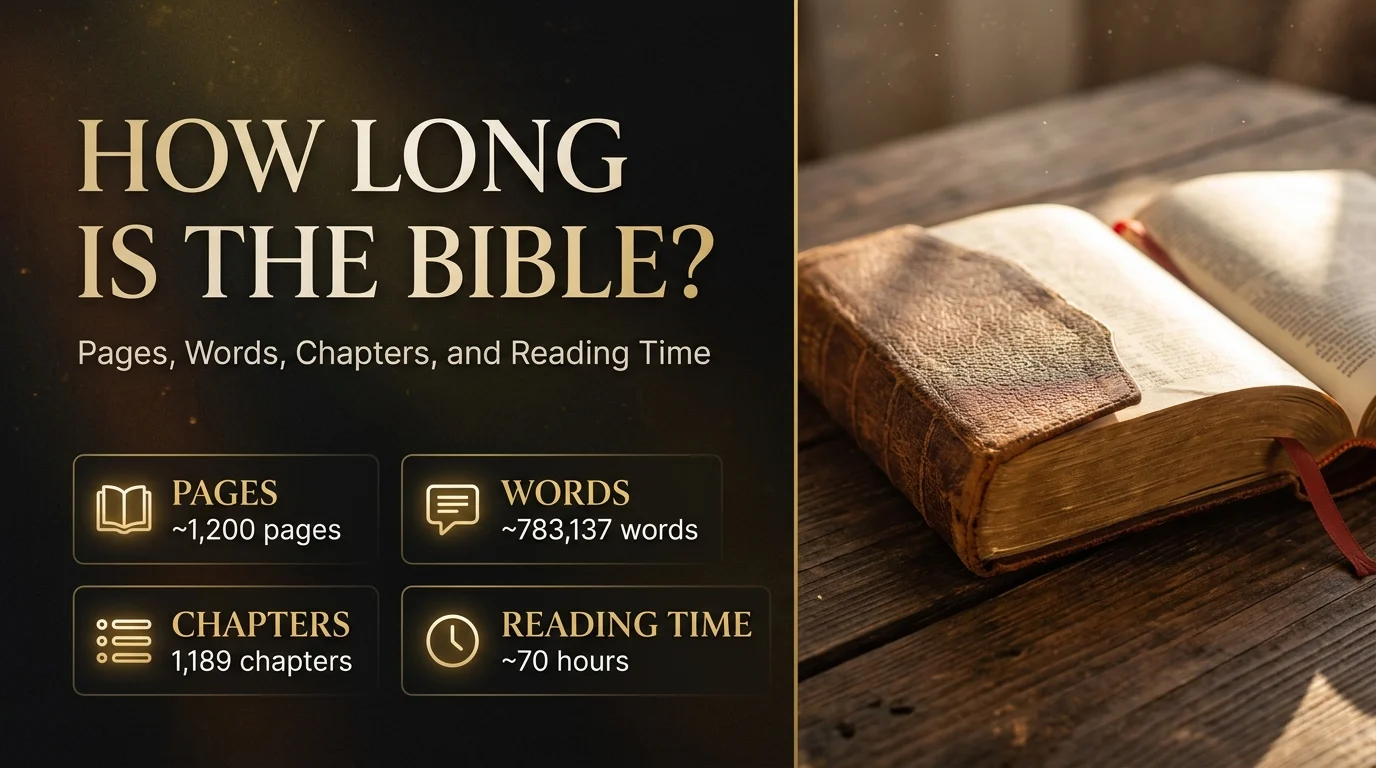
Have you ever wondered how long the Bible is and how much time it takes to read it from beginning to end? The Bible is one of the most widely read books in the world. It contains stories, teachings, prayers, prophecies, poems, and messages about faith, love, forgiveness, and hope. However, its length can surprise many readers.
The answer depends on which Bible translation and edition you read. Some Bibles contain more books, words, and pages than others. For example, Protestant Bibles have 66 books, while Catholic Bibles have 73 books. Orthodox Bible editions may contain even more.
If you want to study the Bible, finish reading it in a year, or simply understand its size, knowing its length can help you make a realistic plan. In this guide, you will learn how many words, chapters, and verses the Bible contains, how long it takes to read, and what makes different editions vary in size.
How Long Is the Bible? Meaning and Definition
The question “How long is the Bible?” usually refers to its total length in pages, words, chapters, verses, or reading time. There is no single answer because the Bible comes in different translations, formats, and editions.
Here is a quick overview of its length.
| Bible measurement | Approximate amount |
|---|---|
| Books in a Protestant Bible | 66 |
| Books in a Catholic Bible | 73 |
| Chapters in a standard Protestant Bible | 1,189 |
| Verses in a standard Protestant Bible | 31,102 |
| Words | Roughly 750,000–800,000 in many English editions |
| Printed pages | Often 1,000–2,000, depending on the edition |
| Reading time | Approximately 70–90 hours |
These figures are estimates. Exact word and page counts depend on the translation, printing layout, and books included.
How Many Books Are in the Bible?
A Protestant Bible contains 66 books: 39 in the Old Testament and 27 in the New Testament.
A Catholic Bible contains 73 books, including additional Old Testament books known as the deuterocanonical books. Eastern Orthodox editions may include additional texts, depending on the church tradition.
The Old Testament describes creation, Israel’s history, God’s laws, wisdom, and the words of the prophets. The New Testament focuses on Jesus Christ, His teachings, His death and resurrection, and the growth of the early Christian church.
How Many Chapters and Verses Are There?
A standard Protestant Bible contains 1,189 chapters and approximately 31,102 verses. The Old Testament has 929 chapters, while the New Testament has 260.
These chapter and verse divisions help readers find specific passages. They were added to make the Bible easier to navigate and are not the original structure of every biblical book.
Background: Why Does the Bible Have Different Lengths?
The Bible developed over many centuries. It is a collection of sacred writings rather than a single book written at one time by one author. Its books include different literary styles, historical settings, and religious teachings.
The Old Testament contains books such as Genesis, Psalms, Isaiah, and Proverbs. The New Testament includes the four Gospels, Acts, letters written to early Christian communities, and Revelation.
Different Christian traditions recognize different collections of books. This is one reason Bible editions do not all have the same length.
Why Do Bible Translations Differ?
English Bible translations use different approaches to presenting the original Hebrew, Aramaic, and Greek texts.
Some translations use language that closely follows the original wording. Others focus on expressing the meaning in clear, modern English. These choices can affect the number of words in a passage.
For example, the King James Version, New International Version, and English Standard Version may express the same verse using different numbers of words.
The physical format also matters. A compact Bible with small print may contain more words per page than a large-print edition. Study Bibles often include introductions, maps, notes, cross-references, and explanations that increase the total page count.
Is the Bible the Longest Book in the World?
The Bible is a large and influential collection of writings, but it is not necessarily the longest book by word count. Some modern novels, encyclopedias, and other collections contain more words.
Its importance comes from its religious, historical, literary, and cultural influence, not simply its length.
How Long Does It Take to Read the Entire Bible?
The time required to read the Bible depends on your reading speed, the translation you choose, and how carefully you study each passage.
A complete English Bible may contain roughly 750,000–800,000 words, although the total varies. An average adult reading at 200–250 words per minute could finish that amount in approximately 50–67 hours of continuous reading. In practice, breaks, difficult passages, and reflection can make the process longer.
For many readers, a more realistic estimate is around 70–90 hours.
Bible Reading Plans
You can divide the reading into manageable daily sessions.
| Reading schedule | Approximate daily reading |
|---|---|
| 30 days | About 40 chapters per day |
| 90 days | About 13–14 chapters per day |
| 6 months | About 6–7 chapters per day |
| 1 year | About 3–4 chapters per day |
These plans are approximate. Chapters vary greatly in length, so the amount of time required each day will differ.
If you read the Bible for 15–20 minutes daily, you can make steady progress. Reading for 20–30 minutes a day may help you finish within a year, depending on your speed and study habits.
What Is the Best Way to Read the Bible?
Start with a plan that fits your schedule. You could read Genesis to Revelation in order, follow a chronological plan, or begin with the Gospels to learn about the life and teachings of Jesus.
Keep a notebook for meaningful verses and questions. If a passage is difficult, read it again and consider its historical context. The goal is not only to finish the Bible but also to understand its message.
How Long Is the Bible in Different Contexts?
People ask about the Bible’s length for several reasons. Some want to purchase a Bible, others need information for school, and many want to begin a personal reading journey.
In Education and Research
Students may need the Bible’s word count, number of books, or chapter total for a school assignment. Researchers may compare translations, literary styles, or historical traditions.
When writing an academic paper, identify the Bible edition you are using. This makes your word counts and references easier to verify.
In Churches and Bible Study Groups
Churches may use the Bible’s length to plan group studies, reading challenges, and teaching schedules. A group might study one book each week or follow a year-long plan.
The right schedule depends on whether participants read for general understanding, theological study, or personal reflection.
In Publishing and Book Design
Publishers consider font size, page dimensions, paper quality, and additional study materials when producing a Bible. A standard edition may be relatively compact, while a study Bible can be much thicker.
Therefore, page count alone does not accurately measure how much biblical text an edition contains.
Does “How Long Is the Bible?” Have a Meaning on Chat, WhatsApp, Instagram, or TikTok?
The phrase “How long is the Bible?” is a straightforward question, not a common abbreviation or internet slang term.
On WhatsApp, someone might ask it while discussing religion or planning a reading challenge. On Instagram or TikTok, the question may appear in educational videos, Christian content, book reviews, or Bible study discussions.
For example:
- “How long is the Bible? I want to read it this year.”
- “Can someone tell me how many pages the Bible has?”
- “I’m starting a Bible reading challenge. How long will it take?”
In these situations, the person generally wants information about the Bible’s size or the time needed to read it.
The phrase can also appear in dating app conversations when people discuss religious beliefs or personal values. However, it has no special romantic meaning on its own.
Does the Bible’s Length Have a Meaning in Physics, Medicine, or Aircraft Terminology?
The words “How long is the Bible?” do not have a recognized technical meaning in physics, medicine, or aircraft terminology.
In physics, the word “length” usually refers to the distance between two points or the dimensions of an object. If someone measures a physical Bible, its length could mean its height, width, or thickness.
In medicine, the Bible is not a standard medical measurement or diagnostic term. A medical professional would use the word “length” in specific contexts, such as measuring a body part or an object.
In aviation, the Bible is not a standard aircraft measurement or operational abbreviation. Aircraft terminology uses specific terms for runway length, wingspan, fuselage length, and other dimensions.
If you encounter the phrase in one of these fields, check the surrounding context. It may be a literal question, a reference to a publication, or a misunderstanding rather than a technical expression.
Common Misconceptions About the Bible’s Length
Several misunderstandings can make the Bible’s size seem confusing.
Every Bible Has the Same Number of Pages
This is incorrect. Page counts change with the translation, font, paper, book dimensions, and extra study materials.
All Christian Bibles Contain 66 Books
Not all of them do. Protestant Bibles generally contain 66 books, Catholic Bibles contain 73, and Orthodox traditions may use larger collections.
Every Bible Contains Exactly the Same Number of Words
Word counts vary between translations and editions. Even small differences in wording can change the total.
Reading the Bible in a Year Is Too Difficult
A year-long plan can make the task manageable. Reading a few chapters daily is often enough to maintain steady progress, although some chapters take longer than others.
You Must Read Every Page Quickly to Understand It
Speed is not the most important factor. Taking time to understand a passage, reflect on its message, and consider its context may be more valuable than rushing to finish.
Similar Questions and Alternatives
People who search for the Bible’s length often have related questions.
- How many pages are in the Bible? This depends on the edition and its layout.
- How many words are in the Bible? The answer varies by translation and collection of books.
- How many chapters are in the Bible? A standard Protestant Bible has 1,189 chapters.
- How many verses are in the Bible? A standard Protestant Bible has approximately 31,102 verses.
- How long does it take to read the Bible? Many readers can complete it in roughly 70–90 hours, depending on reading speed and study habits.
- How long is the Old Testament? It contains 39 books in Protestant Bibles and forms the larger portion of the biblical collection.
- How long is the New Testament? It contains 27 books in standard Christian Bibles.
These questions address different measurements. Knowing which one matters to you will help you find a more precise answer.
How to Respond When Someone Asks, “How Long Is the Bible?”
If someone asks this question in a conversation, give a simple answer and explain that the exact length depends on the edition.
Here are a few natural responses:
Short answer: “A standard Protestant Bible has 66 books and about 1,189 chapters.”
If they mean reading time: “It usually takes around 70–90 hours to read the entire Bible, depending on your pace.”
If they mean page count: “Many editions have around 1,000–2,000 pages, but the number varies.”
If they want to start reading: “You can finish the Bible in a year by reading a few chapters each day.”
These responses provide useful information without overwhelming the other person with details.
Differences Between Bible Length, Word Count, and Reading Time
Although these terms are related, they describe different things.
Bible length is a general term that can refer to the number of pages, chapters, words, or total reading time.
Word count measures the number of words in a particular translation or edition. It is useful for comparing the size of different texts.
Page count measures how many printed pages an edition contains. It depends heavily on formatting and extra content.
Reading time estimates how long someone needs to read the text. Reading speed, breaks, and reflection all affect the result.
For example, two Bibles may contain nearly the same biblical text but have very different page counts because one uses larger print or includes extensive study notes.
Understanding these differences helps you avoid assuming that a thicker Bible necessarily contains more biblical books or words.
Why the Bible’s Length Matters in Online Conversations and Dating Apps
The Bible’s length can become a topic in online conversations about Christianity, spirituality, literature, and personal growth.
On social media, someone might ask how long the Bible is because they want to join a reading challenge or understand a Christian reference. In a dating app conversation, the question may come up when two people discuss faith, church attendance, or religious traditions.
The question itself does not indicate a person’s beliefs or level of religious commitment. Someone may be curious about the Bible for academic, cultural, historical, or personal reasons.
If the topic comes up while getting to know someone, a thoughtful response can encourage a meaningful conversation. You might explain the difference between Bible editions and then ask whether the person is interested in reading it.
Approach the discussion with respect. People have different religious backgrounds and levels of familiarity with the Bible, so a clear and friendly explanation is usually the best response.
Conclusion
So, how long is the Bible? The answer depends on the edition, translation, and measurement you use. A standard Protestant Bible contains 66 books, 1,189 chapters, and approximately 31,102 verses.
Many English editions contain roughly 750,000–800,000 words, while printed versions often range from 1,000 to 2,000 pages. Reading the entire Bible may take around 70–90 hours, depending on your pace and whether you pause to study.
If your goal is to read the Bible, you do not need to finish it all at once. Start with a few chapters each day and choose a schedule you can maintain.
If you read for faith, education, or personal understanding, taking time to reflect on its message can make the experience more meaningful. The Bible is a large collection of writings, but a simple daily plan can help you explore it one passage at a time.