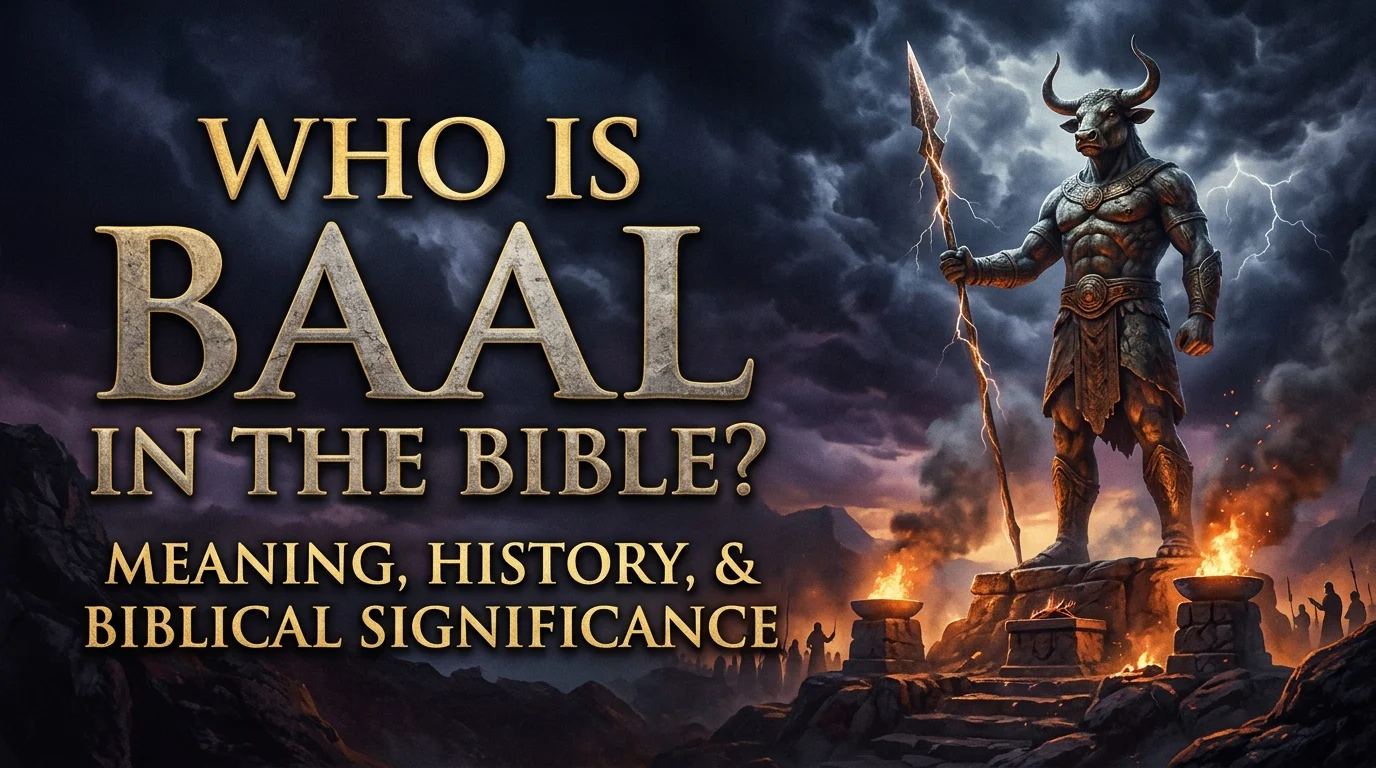
Who is Baal in the Bible, and why is this name connected with idol worship and spiritual conflict? Baal is one of the most frequently mentioned false gods in the Old Testament. In ancient Canaan, many people worshiped Baal because they believed he controlled rain, storms, fertility, and agricultural growth. They looked to him for good harvests and prosperity.
However, the Bible presents Baal as a false god whose worship often led the Israelites away from the one true God, the Lord. Several biblical stories describe how God’s people struggled with the temptation to follow Baal instead of remaining faithful to Him.
One of the best-known accounts appears in 1 Kings 18, when the prophet Elijah confronts the prophets of Baal on Mount Carmel. This dramatic event demonstrates the difference between the worship of a false god and faith in the living God.
Understanding Baal’s identity, historical background, and role in Scripture helps readers understand the Bible’s teachings about faith, obedience, idolatry, and devotion to God.
1. Meaning and Definition of Baal in the Bible
The word Baal comes from a Hebrew word meaning “lord,” “master,” or “owner.” In ancient times, the term could describe a person who possessed authority over someone or something. However, Baal is best known in the Bible as the name of a Canaanite deity.
The people of ancient Canaan associated Baal with storms, rain, and agricultural fertility. Since farming depended heavily on rainfall, many believed that Baal could provide the conditions needed for successful crops and healthy livestock.
The Bible strongly condemns the Israelites’ worship of Baal because it violated their covenant with God. According to the biblical account, the Israelites were called to worship the Lord alone rather than turn to the gods of surrounding nations.
Why Was Baal Worship Wrong in the Bible?
Baal worship was wrong because it encouraged the Israelites to abandon their devotion to God. The first commandment states:
“You shall have no other gods before me.” — Exodus 20:3 (ESV)
This command established that the Israelites were not to worship other gods alongside the Lord.
In the biblical narrative, Baal worship represents more than a different religious tradition. It becomes a symbol of spiritual unfaithfulness, disobedience, and the temptation to trust something other than God.
Is Baal a Real God According to the Bible?
The Bible describes Baal as a god worshiped by other nations, but it does not recognize him as a true divine rival to the Lord. Instead, Scripture repeatedly challenges the claims of false gods and emphasizes God’s unique power and authority.
For example, Psalm 115:4–8 describes idols as human-made objects that cannot speak, see, hear, or act independently.
The central biblical lesson is that Baal was worshiped by many ancient people, but the Bible calls its readers to place their faith in the one true God.
2. Historical Background of Baal
Baal worship existed in the ancient Near East long before many of the events recorded in the biblical books of Kings. Historical evidence from ancient Canaan and nearby regions shows that Baal was an important deity in the religious beliefs of several communities.
In Canaanite religion, Baal was commonly associated with storms, thunder, rain, and fertility. Some ancient texts portray him as a powerful storm god who brought rain to the land. This connection made him especially important to farming communities that depended on seasonal weather.
The name Baal could also appear in different forms and local religious titles. In some contexts, it referred to a particular deity, while in others it formed part of a place-name or the name of a person.
Baal and the Israelites
According to the Old Testament, the Israelites repeatedly faced pressure to adopt the religious practices of the surrounding peoples. The Bible describes several periods when they turned away from the Lord and worshiped Baal.
Judges 2:11–13 explains that the Israelites did evil in God’s sight and served the Baals. The passage connects their behavior with abandoning the Lord who had brought them out of Egypt.
The biblical writers present this pattern as a recurring problem: the Israelites would turn toward other gods, experience the consequences of their disobedience, and sometimes return to the Lord.
Baal During the Reign of Ahab
Baal worship became especially prominent in the biblical account of King Ahab of Israel. According to 1 Kings 16:30–33, Ahab married Jezebel, the daughter of the king of the Sidonians, and began serving Baal.
Ahab also built an altar and a temple for Baal in Samaria. His actions represented a serious religious conflict within Israel.
The prophet Elijah confronted this situation by challenging the prophets of Baal on Mount Carmel. The account in 1 Kings 18 became one of the Bible’s most memorable demonstrations of the conflict between worshiping Baal and remaining faithful to God.
This historical background helps explain why Baal appears so often in biblical discussions of idolatry and Israel’s spiritual struggles.
3. The Biblical Significance of Baal
Baal is important in the Bible because his worship reveals the struggle between faithfulness to God and the influence of surrounding religious practices. Several passages describe this conflict and show how biblical prophets challenged the worship of false gods.
Elijah and the Prophets of Baal
The story of Elijah and the prophets of Baal appears in 1 Kings 18:20–40.
Elijah gathered the Israelites and challenged them to stop wavering between the Lord and Baal. He proposed a test: the prophets of Baal would prepare a sacrifice, and Elijah would prepare another. Neither side would light its own offering. The deity who answered with fire would demonstrate divine power.
The prophets of Baal called upon their god, but no answer came. Elijah then prayed to the Lord, and fire fell from heaven, consuming his offering.
The people responded by acknowledging the Lord’s power.
The story emphasizes that the God of Israel does not depend on human manipulation or rituals to prove His authority.
Baal and Spiritual Unfaithfulness
The Bible sometimes compares Israel’s worship of other gods to unfaithfulness in a relationship. In the prophetic books, idolatry is portrayed as a betrayal of the covenant between God and His people.
Hosea 2 uses marriage imagery to describe Israel’s spiritual unfaithfulness and God’s continuing desire to restore His people.
This imagery teaches readers that faith involves more than outward religious activity. It includes loyalty, trust, obedience, and a sincere relationship with God.
What Christians Can Learn From Baal’s Story
The story of Baal offers several lessons for Christian readers:
- Worship God alone: Biblical faith calls for wholehearted devotion to the Lord.
- Recognize false priorities: Anything that takes God’s place in a person’s life can become an unhealthy source of trust or devotion.
- Choose faith over pressure: Elijah’s example encourages believers to remain faithful even when others choose differently.
- Examine the heart: Religious commitment involves sincere trust and obedience, not simply outward appearances.
These lessons make Baal’s story relevant to readers seeking to understand the Bible’s teaching about worship and spiritual integrity.
4. Baal in Different Contexts: Biblical, Historical, and Modern Usage
The meaning of Baal depends on the context in which the word appears. It is not a modern slang expression with one universal meaning.
Biblical Context
In the Bible, Baal usually refers to a Canaanite deity or to the religious worship associated with that deity. The name appears in historical narratives, prophetic warnings, and discussions of Israel’s unfaithfulness.
For example, 1 Kings 18 focuses on the conflict between Elijah and Baal’s prophets, while Judges 2 describes the Israelites turning toward the Baals.
Historical and Academic Context
Historians and scholars of ancient religion use the term Baal when discussing Canaanite beliefs, ancient inscriptions, and religious practices in the ancient Near East.
In these discussions, Baal is studied as a historical religious figure rather than as a modern communication term.
Social Media and Online Discussions
On social media, Baal may appear in posts about Bible studies, Christian teachings, ancient history, mythology, or spiritual topics. A user might ask, “Who was Baal in the Bible?” or share a passage about Elijah’s confrontation with Baal’s prophets.
The meaning depends on the content of the post. It generally refers to the biblical or historical figure rather than a texting abbreviation.
Professional and Educational Contexts
In academic writing, Baal may be discussed in theology, biblical studies, archaeology, and ancient history. In these settings, writers usually explain the historical period and religious context to avoid confusion.
The name can also appear in discussions of literature, comparative religion, and ancient Near Eastern culture.
Understanding the context is essential because the same word can be used in biblical teaching, historical research, or casual online discussion without changing its basic historical reference.
5. Does Baal Have a Meaning on WhatsApp, Instagram, or TikTok?
Baal does not have a widely established meaning as a texting abbreviation on WhatsApp, Instagram, or TikTok. When it appears on these platforms, it most often refers to the biblical deity or the ancient religious tradition associated with him.
Baal on WhatsApp
Someone might send a Bible verse, church-study message, or question about Baal in a private conversation. In that situation, the sender is probably discussing biblical history or Christian beliefs.
Baal on Instagram
Instagram posts may mention Baal in religious education, Bible-study content, historical discussions, or videos explaining Old Testament stories.
For example, a caption might read, “Elijah stood against the prophets of Baal.” This refers to the story in 1 Kings 18.
Baal on TikTok
TikTok creators may use the name when discussing biblical figures, ancient mythology, or the difference between the Lord and the gods worshiped in ancient Canaan.
However, a particular creator could use the word in a fictional story, username, game, or unrelated context. The surrounding content determines the intended meaning.
Important: Baal is not a standard abbreviation like “LOL,” “BRB,” or “ICYMI.” If you see the word online, read the surrounding message before assuming what the sender means.
6. Does Baal Have a Meaning in Physics, Medicine, or Aviation?
Baal is not a standard scientific term in mainstream physics, medicine, or aviation. Its established meaning is primarily religious and historical.
Baal in Physics
In physics, Baal is not a recognized general term for a force, particle, measurement, or scientific law. If the word appears in a scientific discussion, it may be a name used in a fictional example, a proper noun, or a specialized reference.
Baal in Medicine
Baal is not a standard medical diagnosis, treatment, or commonly recognized clinical abbreviation. Medical abbreviations can vary between institutions, so an unfamiliar use should be interpreted only after checking the specific document and its context.
Baal in Aviation
Baal is not a standard aviation term for an aircraft component, flight procedure, or navigation system. If the word appears in aviation-related material, it may be a proper name or part of a specific identifier.
In all three fields, readers should avoid assuming that Baal has a technical meaning without reliable context.
7. Common Misconceptions About Baal
Several misunderstandings can make it harder to understand Baal’s role in the Bible.
Misconception 1: Baal Was the God of the Israelites
Baal was worshiped by some Israelites, but the Bible identifies the Lord as the God of Israel. The biblical writers condemn the Israelites’ worship of Baal as a departure from their covenant with God.
Misconception 2: Baal and Satan Are Exactly the Same Figure
The Bible discusses Baal and Satan in different contexts. Baal is associated with ancient Canaanite worship, while Satan appears as an adversarial figure in biblical literature. Some later religious traditions connect pagan gods with demonic forces, but the terms are not interchangeable in every biblical passage.
Misconception 3: Every Use of the Word Baal Refers to an Idol
The Hebrew word can mean “lord,” “master,” or “owner” in certain contexts. Its precise meaning depends on how it is used. When it refers to the Canaanite deity, it has a specific religious meaning.
Misconception 4: Baal Worship Is Only a Story About the Past
The historical worship of Baal belongs to the ancient world, but Christians may apply the Bible’s warnings about idolatry to modern life. These applications are spiritual lessons rather than claims that every modern problem is connected to Baal.
Misconception 5: The Bible Presents Baal as Equal to God
The biblical writers reject this idea. The Mount Carmel story emphasizes the Lord’s authority rather than portraying two equal gods competing for power.
Understanding these distinctions helps readers interpret Scripture accurately without confusing historical facts, theological interpretations, and modern applications.
8. Similar Terms and Alternatives to Baal
Several words appear in biblical discussions of Baal, but they do not all mean the same thing.
- Baal: The name of a Canaanite deity associated with storms, rain, and fertility.
- Asherah: A goddess or religious figure associated with ancient West Semitic religion. The term can also refer to a cult object in biblical contexts.
- Dagon: A deity worshiped by certain ancient Near Eastern peoples, including the Philistines.
- Molech: A name associated in the Bible with condemned religious practices involving offerings of children; its precise historical interpretation is debated.
- Idol: An image or object used in worship, or more broadly something treated as an object of devotion.
- Paganism: A broad term used for religious traditions outside certain major monotheistic faiths, although its meaning varies by historical context.
- Yahweh or the Lord: The name or title used in the Bible for Israel’s God, whom the biblical writers distinguish from Baal.
These terms provide useful historical and religious context, but they should not be treated as synonyms. Each has its own background and meaning.
9. How Should You Respond When Someone Mentions Baal?
Your response should depend on why the person is discussing Baal. You do not need to assume that the mention is a religious challenge or a sign of hostility.
Here are some natural responses:
If someone asks about Baal in a Bible discussion:
“Baal was a Canaanite deity whose worship the Bible condemns. Elijah’s confrontation with Baal’s prophets is described in 1 Kings 18.”
If someone shares a Bible verse about Baal:
“That passage shows how seriously the Bible treats faithfulness to God and the rejection of idolatry.”
If someone mentions Baal in a history discussion:
“Baal was an important deity in ancient Canaanite religion, especially in connection with storms and agricultural fertility.”
If someone uses Baal in an unfamiliar online context:
“What do you mean by Baal here? Are you referring to the biblical figure or something else?”
A respectful question is often the best response when the intended meaning is unclear.
10. How Is Baal Different From Similar Biblical Figures?
Baal is often mentioned alongside other ancient deities, but the figures have different identities and roles.
| Name | Main association | Biblical context |
|---|---|---|
| Baal | Storms, rain, and fertility | Worship condemned by Israel’s prophets |
| Asherah | Ancient West Semitic goddess or cult symbol | Associated with forbidden religious practices in Israel |
| Dagon | Ancient Near Eastern deity | Appears in stories involving the Philistines |
| Molech | Associated with condemned sacrificial practices | Mentioned in biblical prohibitions |
| Yahweh (the Lord) | God of Israel | The one whom the Bible commands Israel to worship |
The most important distinction is between the religious figures worshiped by surrounding nations and the Lord whom the biblical writers identify as Israel’s God.
Baal’s story is particularly important because it appears in accounts about Israel’s covenant, the ministry of Elijah, and the struggle against idolatry.
11. Baal’s Relevance in Online Conversations and Dating Apps
Baal does not have a standard romantic meaning or widely recognized dating-app definition. If you encounter the name on a dating profile, in a direct message, or in a social media conversation, its meaning depends on the person’s intended use.
For example, someone might mention Baal because they are interested in biblical history, ancient mythology, religious studies, or Christian theology. Another person might use the name as a username, a fictional reference, or a reference to a video game or book.
It is therefore unwise to assume that a person is expressing a particular religious belief simply because the name appears in their profile.
If the word comes up during a conversation, you can ask a simple question such as, “Are you referring to Baal from the Bible?” This gives the other person an opportunity to explain their meaning without creating unnecessary tension.
For Christians, discussions about Baal may also lead to questions about faith, worship, and biblical teachings. A respectful conversation can help clarify differences in religious beliefs.
Ultimately, Baal is a historical and biblical name, not a recognized texting abbreviation or dating slang term. Context is the best guide to understanding its meaning in modern online communication.
Conclusion
Baal is an important figure in the Bible because his worship represents one of the major spiritual challenges faced by ancient Israel.
Associated with storms, rain, and fertility in Canaanite religion, Baal attracted worshipers who believed he could influence their harvests and prosperity.
However, the Bible repeatedly warns the Israelites against worshiping Baal and turning away from the Lord.
The story of Elijah on Mount Carmel, recorded in 1 Kings 18, is a powerful example of this conflict. It teaches readers about faithfulness, obedience, and the importance of worshiping God alone.
Today, understanding Baal helps Christians explore biblical history and recognize the Bible’s warnings about misplaced devotion.
Although the name may appear in online discussions, historical studies, or religious conversations, its main meaning remains rooted in ancient religion and Scripture.
The central lesson is clear: the Bible calls believers to remain faithful to God rather than place their ultimate trust in false gods or competing objects of devotion.