
Have you ever wondered why some books are included in the Bible while others are not? The answer often involves the word canonical. Understanding the canonical Bible meaning can help you learn how Christians understand the collection of books that make up the Bible and why those books hold a special place in their faith.
The word canonical refers to something that belongs to an accepted or recognized standard. In a biblical context, it describes the books that are recognized as part of the Bible by a particular religious tradition. These books include familiar writings such as Genesis, Psalms, Matthew, and Romans.
The topic matters because not every ancient religious writing became part of the biblical canon. Different Christian traditions also recognize different collections of biblical books. Learning what canonical means can help you understand biblical history, Christian beliefs, and the importance of Scripture in everyday life.
In this guide, we will explore the definition, background, related terms, and common misunderstandings surrounding the word canonical.
1. Canonical Bible Meaning and Definition
The canonical Bible meaning refers to the books that a religious community officially recognizes as belonging to the Bible. The word canonical comes from canon, which means a rule, standard, or accepted collection.
In Christianity, the biblical canon is the collection of sacred writings accepted as Scripture by a particular Christian tradition. These writings guide Christian beliefs, worship, moral decisions, and spiritual growth.
For example, Genesis is a canonical book in the major Christian traditions. It tells the story of creation, the beginning of humanity, and God’s relationship with His people. The Gospel of Matthew is also canonical and presents the life, teachings, death, and resurrection of Jesus Christ.
A book’s canonical status is different from simply being old, interesting, or religious. Many ancient writings discuss God, faith, history, or spiritual ideas. However, not every such writing is included in the biblical canon.
What Does Canonical Mean in Simple Words?
In simple terms, canonical means officially recognized as part of an accepted collection of Scripture.
Consider these examples:
- Canonical book: A book recognized as Scripture within a particular biblical tradition.
- Biblical canon: The complete collection of books accepted as the Bible by a religious community.
- Canonical Scripture: Writings regarded as authoritative sacred texts within that tradition.
- Noncanonical writing: A religious or historical writing that is not included in that tradition’s biblical canon.
The word does not automatically mean that a book is more beautifully written, more interesting, or more historically useful than every other religious text. It describes the book’s status within a recognized collection.
What Does Canonical Mean Spiritually?
For Christians, canonical Scripture has an important spiritual role. It provides teachings about God’s character, humanity’s relationship with God, sin, forgiveness, salvation, and hope.
For example, 2 Timothy 3:16 describes Scripture as inspired by God and useful for teaching, correction, and training in righteousness. Christians often use this passage to explain why biblical writings are important for spiritual instruction.
Understanding the term canonical helps readers distinguish between the books their tradition accepts as Scripture and other writings that may offer historical information or religious insight.
2. Background: How Did the Biblical Canon Develop?
The biblical canon developed over many centuries. The Bible did not appear as one complete book written by a single author at one time. Instead, it contains many writings composed in different historical settings, including law, poetry, prophecy, history, letters, and accounts of Jesus’ life.
The Old Testament Canon
The Old Testament contains writings associated with the history, faith, and worship of ancient Israel. These include the Law, historical books, poetry, wisdom literature, and prophetic writings.
Jewish communities preserved and recognized sacred writings over time. These Scriptures became the foundation of the Christian Old Testament, although Christian traditions differ in the number and arrangement of books they include.
For instance, Protestant Bibles generally contain 39 Old Testament books. Catholic Bibles include additional books commonly called the deuterocanonical books. Eastern Orthodox traditions may recognize a somewhat different collection.
These differences are important because the word canonical is always connected to the tradition making the recognition.
The New Testament Canon
The New Testament contains 27 books in Protestant, Catholic, and Eastern Orthodox Bibles. These writings include the four Gospels, Acts, letters attributed to apostles and other early Christian leaders, and Revelation.
The early Christian communities circulated teachings, letters, and accounts of Jesus. Over time, church leaders and communities recognized particular writings as authoritative for Christian faith and practice.
Factors involved in recognizing New Testament books included their connection to the apostles or apostolic teaching, their consistency with the faith received by the churches, and their established use among Christian communities.
The process took place over generations rather than through one universally accepted decision made at a single moment.
Why Were Some Books Excluded?
Some ancient writings were not included in particular biblical canons because they did not receive the same recognition or acceptance as the books that became canonical. Others remained important historical or religious documents without becoming Scripture for those communities.
It is misleading to assume that every excluded book was necessarily considered false or that every question about the canon was settled immediately. The history is complex, and different religious communities developed different understandings of which writings belong in Scripture.
The key point: The biblical canon identifies the collection of books recognized as Scripture within a particular religious tradition.
3. Canonical Meaning in Different Contexts
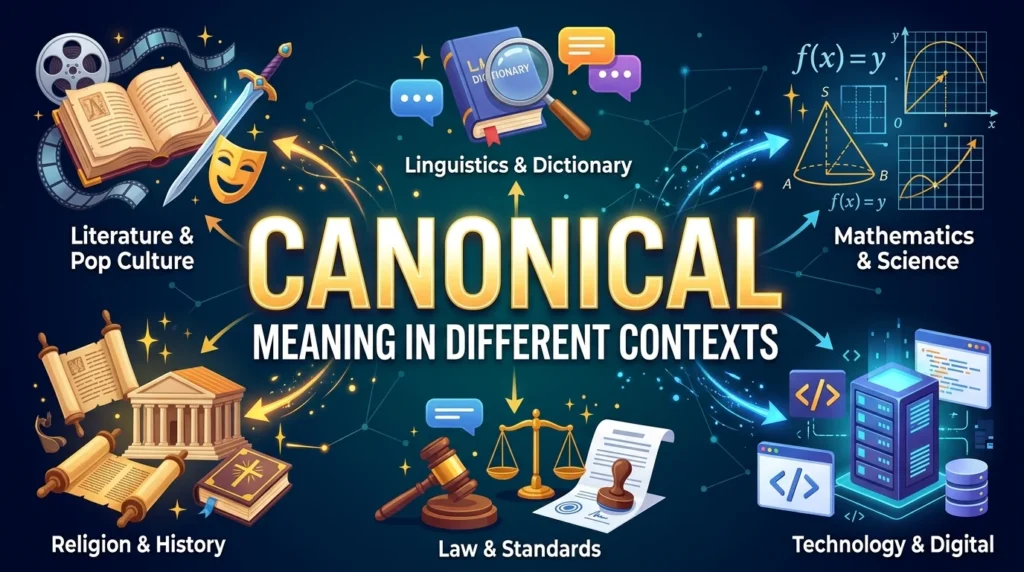
Although canonical is often used in discussions of the Bible, it also appears in literature, religion, education, law, technology, and other fields. Its general meaning remains connected to an accepted standard or recognized collection, but its exact definition depends on the context.
In Religious Studies
In religious studies, canonical describes texts, teachings, or writings recognized as authoritative within a religious tradition.
For example, the phrase canonical Gospel refers to one of the four Gospels included in the New Testament: Matthew, Mark, Luke, or John.
The term can also help scholars compare canonical writings with other early Christian texts. Such comparisons may reveal differences in theology, historical perspectives, and the development of religious communities.
In Literature and History
In literature, a literary canon is a collection of works widely recognized as important within a particular culture, tradition, or academic field.
For example, a university course might study a canon of influential novels, plays, or poems. Here, canonical does not mean biblical or religious. It means recognized as part of an established body of important works.
In historical research, the word can describe an accepted collection of documents or works, although scholars may still debate their significance or interpretation.
In Education and Professional Writing
Teachers may refer to canonical texts when discussing works that are central to a subject. Researchers might use the term for established theories, models, or standard approaches within a discipline.
The word can also describe a recognized form of a text or a standard version of a work.
The important distinction is that canonical does not have exactly the same meaning in every field. In biblical studies, it concerns the recognized books of Scripture. In literature, it often concerns influential works. In other disciplines, it can refer to an accepted rule, standard, or form.
4. Canonical Meaning in Chat, WhatsApp, Instagram, and TikTok
The word canonical is not common everyday texting slang. Unlike abbreviations such as LOL or BRB, it does not have a widely recognized, separate meaning in ordinary chat.
However, people may use it in online discussions about the Bible, religion, books, movies, games, and fictional stories.
Canonical Meaning in Chat
If someone writes, “That is the canonical version,” they usually mean that it is the officially recognized or established version within the relevant context.
For example:
- “This is the canonical Gospel account.” This refers to a Gospel recognized as part of the New Testament.
- “That scene is not canonical.” In a fictional story discussion, this means the scene is not part of the officially recognized storyline.
- “We need the canonical version of the document.” In a work setting, this means the standard or authoritative version.
The exact meaning depends on the subject of the conversation.
Canonical Meaning on WhatsApp
On WhatsApp, the term might appear in a Bible study group, church discussion, academic conversation, or message about a book.
For example:
“Is this book canonical in the Catholic Bible?”
The sender is asking whether the book belongs to the collection of Scripture recognized by the Catholic Church.
Canonical Meaning on Instagram and TikTok
On Instagram and TikTok, users might use canonical in religious educational posts, Bible explanations, historical discussions, or fandom videos.
A creator might explain the difference between canonical biblical books and other ancient religious writings. Another creator might describe a character’s officially established story as canonical.
The word does not have a special meaning simply because it appears on one of these platforms. Its meaning comes from the subject being discussed.
Quick answer: In online conversations, canonical generally means officially recognized, accepted, or established within a particular system or tradition.
5. Canonical Meaning in Physics, Medical, and Aircraft Terminology
The word canonical is also used in scientific and technical fields. Although these meanings are different from the biblical definition, they share the general idea of an accepted or standard form.
Canonical Meaning in Physics
In physics, canonical appears in several technical expressions.
One example is a canonical ensemble in statistical mechanics. It describes a system that can exchange energy with a heat reservoir while its temperature is held constant. The system’s energy can vary, even though the temperature of the larger thermal environment is fixed.
Another example is a canonical transformation in Hamiltonian mechanics. This is a mathematical transformation that preserves the structure of Hamilton’s equations.
These uses are technical. They do not refer to biblical Scripture, religious authority, or Christian beliefs.
Canonical Meaning in Medicine
In medicine and biology, canonical often describes a recognized pathway, standard form, or commonly established mechanism.
For example, a researcher may discuss a canonical signaling pathway when describing a well-characterized way cells communicate or respond to signals.
The term does not necessarily mean that a pathway is the only pathway or that every patient experiences the same biological process. It identifies a recognized framework within a particular scientific context.
Canonical Meaning in Aircraft Terminology
In aviation, canonical is not generally a standard everyday operational term comparable to altitude, airspeed, or flight plan. However, it can appear in technical documents, mathematical models, computer simulations, or engineering discussions involving aircraft.
For example, engineers might use a canonical model or configuration as a standard reference for testing or comparing aircraft designs.
In this context, the word refers to a recognized reference form, not to the Bible.
What Connects These Meanings?
The shared idea is that something is recognized as a standard, established form, or accepted structure within a particular field.
However, the specific definition must always be understood from context. A canonical book in biblical studies and a canonical transformation in physics are entirely different things, even though they use the same word.
6. Common Misconceptions About the Canonical Bible Meaning
Several misunderstandings can make the term canonical confusing. Understanding these distinctions helps readers approach biblical history more accurately.
Misconception 1: Canonical Means the Oldest Religious Writing
A writing does not become canonical simply because it is old. Age can be relevant to historical research, but canonical status concerns whether a religious tradition recognizes a text as part of Scripture.
Some ancient religious writings are not included in particular biblical canons.
Misconception 2: Every Christian Bible Contains Exactly the Same Books
This is incorrect. Different Christian traditions recognize different Old Testament collections.
Protestant Bibles generally contain 66 books, while Catholic Bibles contain 73. Some Orthodox traditions include additional books, depending on the church and edition.
The New Testament collection of 27 books is shared by these major Christian traditions.
Misconception 3: Noncanonical Means Completely False
The word noncanonical does not automatically mean that a text is false, worthless, or historically unimportant.
A noncanonical writing may provide insight into the beliefs, practices, and history of an ancient community. It simply does not belong to the recognized biblical canon of the tradition being discussed.
Its historical reliability and theological value are separate questions that require careful examination.
Misconception 4: Canonical Means Every Passage Has Only One Interpretation
Recognizing a book as Scripture does not mean every Christian interprets every passage in exactly the same way.
Christians may disagree about symbolism, historical context, prophecy, and the application of particular teachings. Different interpretive methods can lead to different conclusions even when readers share the same biblical canon.
Misconception 5: Canonical Is the Same as Inspired
These terms are related but distinct.
- Canonical describes a book’s recognized place within the biblical collection.
- Inspired describes the belief that a text comes through divine inspiration.
- Authoritative describes the standing a text has as a source of religious teaching or guidance.
Many Christians connect these ideas closely, but they are not identical definitions.
Understanding these distinctions helps readers discuss Scripture without confusing the history of the biblical canon with broader questions about faith and interpretation.
7. Similar Terms and Alternatives
Several words are closely related to canonical, but they are not always interchangeable.
| Term | Meaning |
|---|---|
| Canon | The recognized collection of authoritative texts or standards |
| Scripture | Sacred writings regarded as authoritative within a religious tradition |
| Biblical canon | The books recognized as belonging to the Bible |
| Deuterocanonical | A term used especially in Catholic tradition for certain Old Testament books recognized as canonical |
| Apocrypha | A term for religious writings outside a particular canon, with usage varying by tradition |
| Noncanonical | Not included in the canon of the tradition being discussed |
| Authoritative | Recognized as having authority or weight |
| Orthodox | Depending on context, conforming to accepted religious belief or referring to a particular Christian tradition |
Canonical vs. Biblical
Biblical generally means related to the Bible. Canonical is more specific when discussing whether a book belongs to the recognized biblical collection.
For example, a historical study of the Bible is biblical in subject, but it is not itself a canonical book.
Canonical vs. Apocryphal
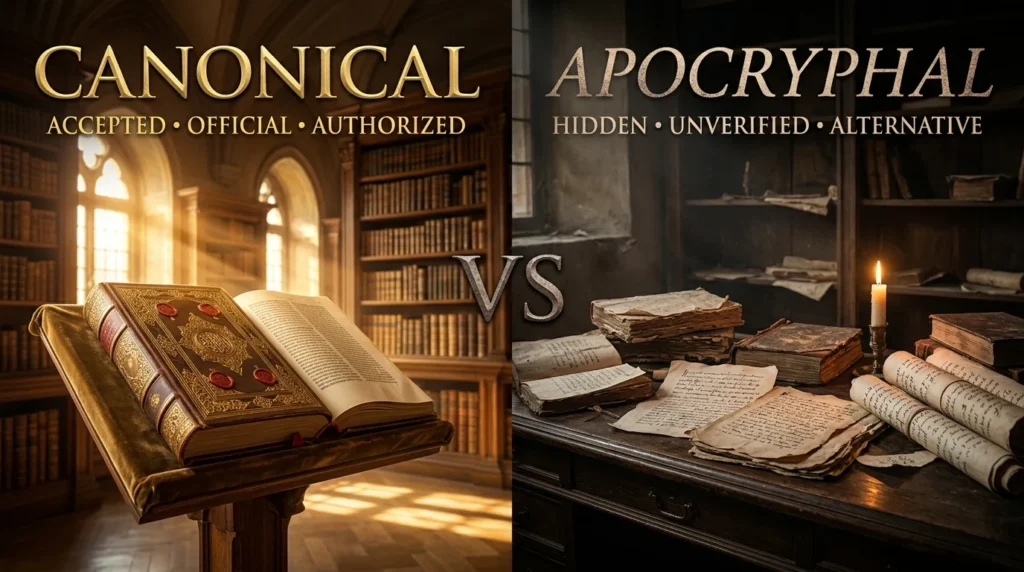
Canonical describes writings included in a particular canon. Apocryphal can describe writings outside that canon, but the term has different historical and denominational uses.
A book may be considered apocryphal in one tradition while being recognized as Scripture in another. This is why it is helpful to identify the tradition before labeling a text.
Canonical vs. Inspired
Inspired concerns the belief that a text is divinely inspired. Canonical concerns its recognized status within the collection of Scripture.
A Christian discussion may involve both ideas, but the terms answer different questions.
Canonical vs. Traditional
Traditional describes something passed down through a community over time. Canonical describes something recognized as part of an accepted canon or standard.
A religious custom can be traditional without being a biblical book. Likewise, a canonical biblical text can be interpreted differently across traditions.
8. How to Respond When Someone Uses the Word Canonical
If someone uses canonical in a conversation, your response should depend on the topic. You do not need to give a complicated explanation if the meaning is clear from context.
In a Bible Study Discussion
If someone asks whether a book is canonical, they want to know whether it belongs to the biblical collection recognized by a particular Christian tradition.
You could respond:
- “Yes, that book is included in the Protestant biblical canon.”
- “Its status depends on the Christian tradition you’re asking about.”
- “Let’s check whether it is recognized as Scripture in that tradition.”
These answers keep the discussion accurate and respectful.
In a Social Media Conversation
If someone says, “That story isn’t canonical,” they may be talking about a movie, television series, video game, or fictional universe.
You could reply:
- “Do you mean it isn’t part of the official storyline?”
- “I thought that version was considered official.”
- “Where was that established?”
Here, canonical concerns the accepted storyline rather than religion.
In a Professional Conversation
If a coworker asks for the canonical version of a document, they probably mean the official or standard version.
A simple response might be:
“Sure, I’ll use the approved version as the reference.”
The main lesson is to consider the subject before responding. A biblical question requires attention to religious tradition, while a scientific or professional question may require a technical definition.
9. Differences Between Canonical and Similar Words
The distinction between canonical and similar words becomes clearer when you consider what each term describes.
Canonical vs. noncanonical: These are opposites when referring to membership in a particular canon. A canonical book belongs to the recognized collection; a noncanonical book does not.
Canonical vs. apocryphal: These terms are sometimes contrasted, but their precise relationship depends on the tradition. The word apocrypha is used differently in Protestant, Catholic, Orthodox, and scholarly contexts.
Canonical vs. authoritative: A canonical text is included in a recognized collection. An authoritative text is regarded as having authority. In Christianity, the ideas are closely connected, but the words describe different aspects of a text.
Canonical vs. accepted: Accepted is a broader word. A community may accept a historical account or religious teaching without considering it part of the Bible.
For example, Christians may value a historical commentary written by an early church leader. That does not make the commentary a canonical biblical book.
These distinctions matter because they help readers discuss religious writings precisely. They also prevent misunderstandings when comparing different biblical traditions.
10. Relevance in Online Conversations and Dating Apps
The word canonical occasionally appears in online communities, including dating discussions, but it is not a widely established dating-app abbreviation or romantic expression.
On dating apps, someone might use the term humorously to describe a familiar experience or an established part of their personal story.
For example:
- “Our coffee date is now a canonical event in our relationship.” This playfully suggests that the date has become an important part of their shared story.
- “That’s a canonical first-date mistake.” This means it is a familiar or typical mistake in the speaker’s view.
- “Is this part of your canonical life story?” This jokingly asks whether an experience is an established part of someone’s personal narrative.
These are contextual uses rather than fixed definitions.
In a religious conversation, however, the term has a more specific meaning. Someone asking about the canonical Bible meaning is generally interested in which books belong to Scripture and why those books matter to Christians.
If you encounter the word online, look at the surrounding conversation. It may refer to biblical authority, an official fictional storyline, a standard document, or simply a playful description of a memorable experience.
The word itself does not indicate romantic interest, flirting, or a hidden message. Its meaning depends on how the person uses it.
Conclusion
The canonical Bible meaning refers to the books recognized as part of the Bible by a particular religious tradition. These writings form the foundation of Christian Scripture and guide believers in understanding God’s character, spiritual truth, faith, and daily life.
Learning about the biblical canon also explains why different Christian traditions may include different Old Testament books. It helps readers distinguish canonical Scripture from other ancient religious writings without assuming that every noncanonical text is false or unimportant.
The word canonical also appears in literature, science, technology, and online conversations, where it generally refers to an accepted standard or recognized form. Its precise meaning depends on the context.
For Christians studying the Bible, understanding this term is a helpful step toward deeper biblical knowledge. It encourages thoughtful reading, respectful discussion, and a clearer understanding of how Scripture is recognized within different Christian traditions.