Have you ever wondered what makes you look like your parents or why family members often share similar features? The answer begins with DNA. This term appears in science, medicine, health articles, social media posts, and everyday conversations. Understanding its meaning can help you make sense of genetics, family relationships, and human biology.
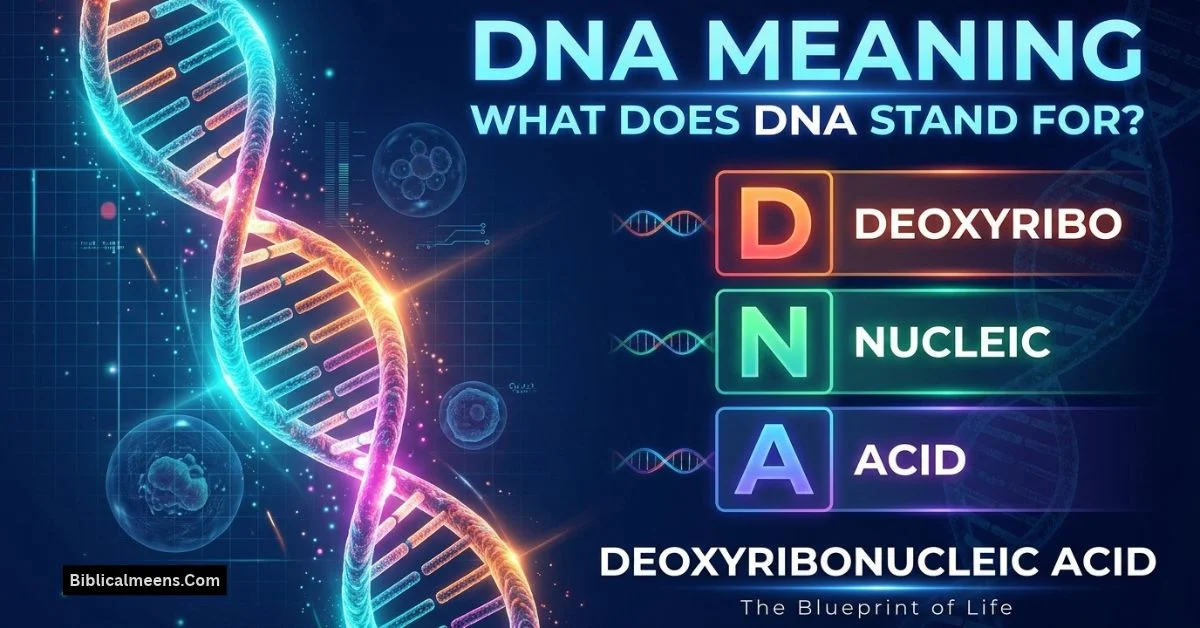
The DNA meaning is deoxyribonucleic acid, a molecule that carries the genetic instructions used by living organisms to grow, develop, function, and reproduce. It contains information that helps determine many inherited traits, such as natural hair color, eye color, and certain aspects of how the body works.
People also use DNA in a figurative way. For example, someone might say, “Music is in my DNA,” meaning that music feels like a natural or deeply rooted part of their identity.
In this guide, you will learn what DNA stands for, how it works, where the term is used, and how its meaning changes in science, online conversations, and everyday life.
1. DNA Meaning and Definition
DNA stands for deoxyribonucleic acid. It is the molecule that stores and passes on genetic information in almost all living organisms.
Think of DNA as a set of biological instructions. These instructions help cells make proteins and perform many essential tasks. Proteins support the structure, growth, repair, and functioning of the body.
DNA is made from smaller units called nucleotides. Each nucleotide contains a sugar, a phosphate group, and one of four chemical bases:
- A — Adenine
- T — Thymine
- C — Cytosine
- G — Guanine
These bases pair in a specific way: adenine pairs with thymine, while cytosine pairs with guanine. The order of the bases carries genetic information.
Most human DNA is found in the nucleus of a cell, organized into structures called chromosomes. A small amount is also found in mitochondria, which help cells produce usable energy.
DNA influences many characteristics, but it does not determine every aspect of a person’s life. Traits such as height, for example, are influenced by many genes as well as nutrition and other environmental factors.
In everyday language, DNA can also refer to the basic qualities that define a person, family, team, company, or culture.
For example:
- “Curiosity is in her DNA” means curiosity seems natural to her.
- “Innovation is part of the company’s DNA” means innovation is central to its identity.
- “They share similar DNA” may refer literally to genetics or figuratively to shared characteristics.
In simple words, DNA is the molecule that carries genetic instructions, while its figurative meaning refers to the basic nature or identity of something.
2. Background and History of DNA
Scientists have studied DNA for more than a century. Their discoveries gradually revealed how genetic information is stored and passed from one generation to the next.
In 1869, Swiss scientist Friedrich Miescher isolated a substance from cell nuclei that he called “nuclein.” Researchers later identified this substance as being associated with DNA.
During the early twentieth century, scientists investigated the relationship between DNA, chromosomes, and inheritance. Experiments by researchers including Oswald Avery and his colleagues helped establish DNA’s role in carrying genetic information.
A major breakthrough came in 1953, when James Watson and Francis Crick proposed a double-helix model of DNA. Their model drew on important experimental evidence, including X-ray diffraction work by Rosalind Franklin and Raymond Gosling, as well as contributions from Maurice Wilkins and others.
The double helix resembles a twisted ladder. The sides consist of sugar and phosphate groups, while the paired chemical bases form the rungs.
This structure helped explain how DNA could store information and be copied when cells divide.
Later discoveries made it possible to read DNA sequences, identify genetic variations, and investigate relationships between genes and health. The Human Genome Project, completed in 2003, produced a landmark reference for studying much of the human genome.
Today, DNA analysis is used in medical research, ancestry testing, forensic investigations, agriculture, and biotechnology.
The term has also become part of everyday speech. People now use DNA as a metaphor for the qualities that make someone or something distinctive.
This figurative usage reflects the scientific idea that DNA carries fundamental biological instructions, although a person’s personality, values, and behavior cannot be explained by genetics alone.
3. DNA Usage in Different Contexts
The meaning of DNA depends on whether someone is discussing biology or using the term figuratively.
In science and education
In biology classes, DNA refers to the molecule that stores genetic information. Students learn about its structure, genes, chromosomes, inheritance, and role in making proteins.
Example: “DNA contains instructions that help cells function.”
In medicine and healthcare
Healthcare professionals and researchers study DNA to understand genetic conditions, investigate inherited risks, and support certain diagnostic decisions.
Genetic testing may identify particular variants associated with a disease, but a result does not always mean someone will develop that condition. Interpretation depends on the variant and the person’s circumstances.
In forensics
DNA profiling can help investigators compare biological samples, such as blood or saliva, with reference samples. It can also help identify human remains or establish biological relationships.
A DNA match must be interpreted carefully. Sample quality, contamination, statistical evidence, and the circumstances of collection all matter.
In business and branding
Companies often use DNA figuratively to describe their identity, values, or defining characteristics.
Example: “Customer service is in our company’s DNA.”
This means customer service is a central part of the organization’s culture.
In everyday conversations
People may use DNA to describe family resemblance, natural abilities, or shared interests.
Example: “Creativity runs in our DNA.”
The statement may refer to inherited tendencies, but it can also be a playful way of saying that creativity is common in the family.
These uses show why context matters. A scientific statement about DNA refers to a biological molecule, while a statement about a team’s DNA usually describes its character or culture.
4. DNA Meaning in Chat, WhatsApp, Instagram, and TikTok
DNA keeps its scientific meaning on social media, but it is also used figuratively in captions, comments, and messages.
DNA meaning in chat
In a private conversation, DNA may refer to genetics or to qualities that feel like a natural part of someone’s identity.
Example:
Friend 1: “You are always making people laugh.”
Friend 2: “Humor is in my DNA!”
The second person means that being funny feels natural to them.
DNA meaning on WhatsApp
On WhatsApp, people may mention DNA while sharing family news, discussing ancestry, or joking about inherited traits.
Example: “We all love dancing. It must be in our DNA.”
The message suggests that dancing is a shared family characteristic, not necessarily a scientifically proven genetic trait.
DNA meaning on Instagram
Instagram captions often use DNA to describe identity, passions, and personal style.
Examples include:
- “Travel is in my DNA.”
- “Creativity is part of my DNA.”
- “Family is in our DNA.”
These expressions communicate that something is central to the person’s life or identity.
DNA meaning on TikTok
TikTok creators may use DNA in videos about family resemblance, genetics, ancestry, or personal interests. It can also appear in humorous trends that compare relatives or highlight shared habits.
For example, a video showing siblings making the same facial expressions might use the caption, “It’s in our DNA.”
The caption is usually playful and does not prove that the behavior is genetically inherited.
Does DNA have a special slang meaning?
DNA is not primarily a texting abbreviation. It already has a widely established scientific definition. Its figurative meaning is common online, but the exact interpretation depends on the post or conversation.
If someone sends “DNA” without context, you can ask what they mean rather than assuming it is a secret code or a special form of internet slang.
5. DNA Meaning in Physics, Medical, and Aircraft Terminology
DNA is most strongly associated with biology and genetics. However, people may encounter the term in other technical fields or in documents that contain multiple abbreviations.
DNA in physics
DNA is not a standard abbreviation for one universal physics concept. However, DNA can be studied using physics-based methods, including X-ray diffraction, spectroscopy, and molecular modeling.
For example, researchers use physical techniques to investigate DNA’s structure, movement, and interactions with other molecules.
If DNA appears in a physics textbook, check the surrounding discussion to determine whether it refers to the biological molecule or a locally defined abbreviation.
DNA in medical terminology
In medicine, DNA means deoxyribonucleic acid. It is important in genetics, inherited conditions, certain cancer investigations, and laboratory testing.
Doctors may recommend genetic tests to investigate specific health concerns or assess certain inherited risks. However, DNA tests cannot predict every disease or explain every symptom.
The results must be interpreted in the appropriate clinical context.
DNA in aircraft and aviation terminology
DNA is not a universal abbreviation for one standard aircraft system or aviation procedure. In aviation documents, the letters might appear as a code, identifier, or specialized abbreviation defined by the relevant organization.
If you encounter DNA in a flight-related document, consult its glossary or official documentation instead of assuming it refers to an aircraft component.
Important: The biological definition of DNA is well established, but abbreviations in technical documents can have specialized meanings. Always verify the context when accuracy matters.
6. Common Misconceptions About DNA
DNA is widely discussed, but several common misunderstandings can lead to incorrect conclusions.
Misconception 1: DNA determines everything about you
DNA influences many biological traits, but it does not control every part of your life. Environment, learning, experiences, and personal choices also influence how people develop.
Misconception 2: Everyone has completely different DNA
Humans share the vast majority of their DNA. Differences in genetic sequences contribute to individual variation, but people are genetically much more alike than different.
Misconception 3: DNA tests reveal your entire ancestry
An ancestry test estimates relationships to reference populations using selected genetic markers. Results depend on the company’s database and methods, so they do not provide a perfect or complete account of someone’s family history.
Misconception 4: A DNA match always proves guilt
DNA evidence can be valuable in forensic investigations, but a match does not automatically establish guilt. Investigators must consider how the sample was collected, possible contamination, transfer, and other evidence.
Misconception 5: Figurative DNA means a trait is genetic
When someone says, “Leadership is in my DNA,” they usually mean leadership feels central to their identity. The phrase is not scientific proof that leadership is inherited.
Understanding these distinctions helps you separate established genetic facts from casual expressions and exaggerated claims.
7. Similar Terms and Alternatives to DNA
DNA is related to several other biological terms, but they do not all mean the same thing.
| Term | Meaning | How it differs from DNA |
|---|---|---|
| RNA | Ribonucleic acid | Helps carry out genetic instructions and has other cellular roles |
| Gene | A DNA sequence that contributes to a functional product | A gene is a section of DNA, not the entire molecule |
| Genome | An organism’s complete set of genetic material | Includes all of an organism’s DNA, with some important distinctions in how the term is used |
| Chromosome | An organized structure containing DNA and associated proteins | Packages genetic material in cells |
| Genetics | The study of genes, inheritance, and variation | A scientific field rather than a molecule |
| Heredity | The passing of traits from parents to offspring | A biological process involving genetic information and sometimes other inherited factors |
For example, DNA contains genes, and genes are organized into chromosomes in the nucleus of human cells. Together, these concepts help explain how genetic information is stored and inherited.
In everyday language, alternatives to figurative DNA include “core identity,” “essential nature,” “foundation,” and “defining qualities.”
For instance, instead of saying “Creativity is in our DNA,” a company might say, “Creativity is central to our identity.”
These alternatives are useful when you want to express the same general idea without using a biological metaphor.
8. How to Respond When Someone Uses DNA
Your response depends on whether the person is discussing genetics or using DNA figuratively.
When someone says, “It’s in my DNA”
They usually mean something feels natural or central to their identity.
You could respond:
- “That makes sense!”
- “You really do seem passionate about it.”
- “I can definitely see that in you.”
When someone talks about family resemblance
If a friend says, “We have the same smile. It’s in our DNA,” you could reply, “You really do look alike!”
When someone discusses genetic testing
If the conversation concerns ancestry or health, ask relevant questions without assuming the results explain everything.
For example: “What did the test tell you?” or “Did you discuss the results with a healthcare professional?”
When someone uses DNA in a scientific discussion
If you are unsure about a technical point, ask for clarification. You could say, “Are you talking about genes or the entire genome?”
When the meaning is unclear
A simple question works well: “Do you mean DNA in the genetic sense, or are you using it to describe someone’s personality?”
This response helps you understand the message without making assumptions.
9. DNA Meaning in Online Conversations and Dating Apps
On dating apps and social media, DNA often appears as a metaphor for personality, values, family background, or shared interests.
Someone might write, “Adventure is in my DNA,” to communicate that they enjoy traveling, exploring new places, and trying new experiences.
Another person might say, “Kindness is in her DNA,” to describe someone who seems naturally caring.
In dating conversations, these phrases can help people express what matters to them. For example:
Person A: “Music is in my DNA. I listen to it every day.”
Person B: “Same here! What kind of music do you like?”
Here, DNA communicates a strong personal interest rather than a literal genetic claim.
The term may also appear in conversations about family history, ancestry, or biological relationships. In those situations, it can have a literal scientific meaning.
However, using DNA in a dating profile does not automatically reveal anything about a person’s genetic traits, compatibility, or romantic intentions. It is usually a descriptive expression.
If someone uses the phrase in a message, consider the full context. They may be sharing a hobby, describing their identity, talking about family, or discussing genetics.
A thoughtful follow-up question can help you learn more about what they mean.
Conclusion
The DNA meaning is deoxyribonucleic acid, the molecule that stores genetic information in living organisms.
It helps guide cellular functions, supports inheritance, and influences many biological traits. Scientists also study DNA in medicine, forensics, ancestry research, and biotechnology.
In everyday conversations, DNA often has a figurative meaning. Phrases such as “It’s in my DNA” describe something that feels natural, deeply rooted, or central to a person’s identity. You may see these expressions on WhatsApp, Instagram, TikTok, and dating apps.
It is important to distinguish scientific facts from casual language. DNA influences many traits, but it does not determine every part of a person’s personality, future, or behavior.
Now that you understand the meaning of DNA, you can recognize how the term works in different contexts.
Whether you encounter it in a science lesson, a medical discussion, or a social media caption, the surrounding information will help you understand its intended meaning.