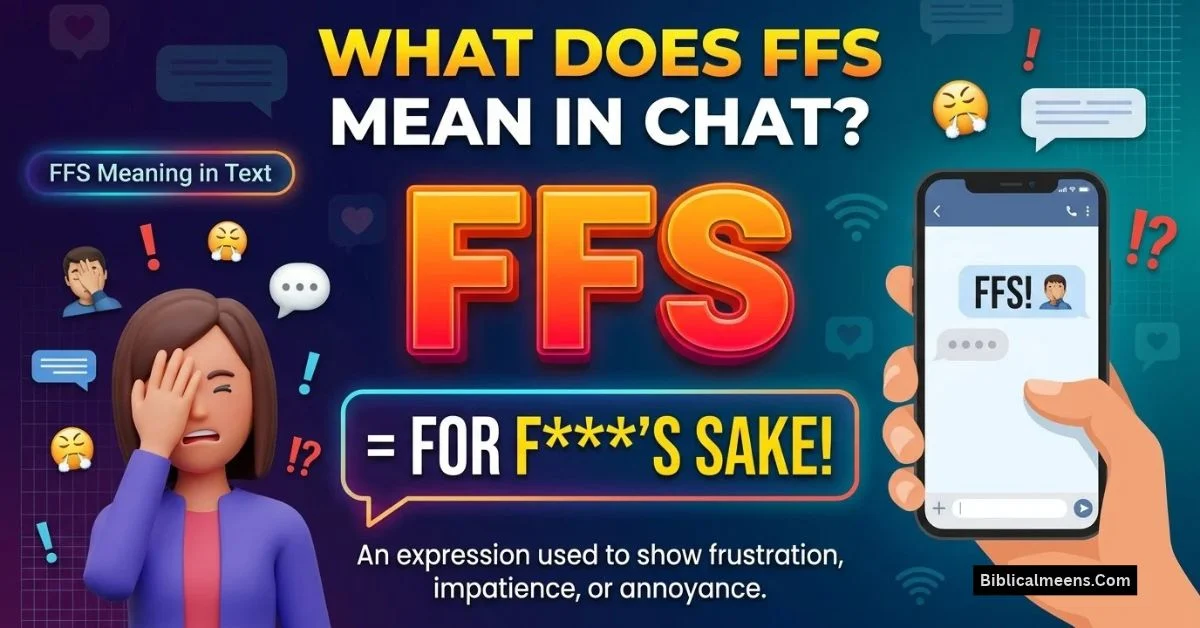
Have you ever received a message containing “FFS” and wondered what the person meant? Internet conversations are full of abbreviations, and some can be confusing if you have never seen them before. FFS is one of those expressions that can carry a strong emotional tone.
The FFS meaning in texting is usually “For F*’s Sake.”** People use it to express frustration, annoyance, disbelief, or impatience. It often appears when something goes wrong, someone repeats a mistake, or a situation becomes irritating.
For example, a person might text, “FFS, I forgot my keys again!” The message shows that the person is frustrated with themselves.
You may see FFS on WhatsApp, Instagram, TikTok, Snapchat, gaming chats, and dating apps. Although it is common in informal online communication, it contains profanity and may sound rude in some situations.
In this guide, you will learn what FFS means, how people use it, what emotions it communicates, and how to respond when someone sends it to you.
1. FFS Meaning and Definition
FFS stands for “For F*’s Sake,”** a profanity-based expression used to show frustration, irritation, impatience, or disbelief.
People often use it when something annoying happens or when they feel that a situation should be obvious or easy to fix.
For example:
Person A: “I missed the bus again.”
Person B: “FFS, you need to leave earlier!”
In this example, the sender expresses frustration about the repeated problem. Depending on their relationship, the message might sound playful, concerned, or genuinely angry.
Here are some common situations in which people use FFS:
- Frustration: “FFS, my computer crashed again.”
- Impatience: “FFS, can we please hurry up?”
- Disbelief: “FFS, you did that again?”
- Self-directed annoyance: “FFS, I forgot my wallet.”
- Emphasis: “FFS, just listen for a second.”
The meaning depends on the conversation and the sender’s tone. Some people use FFS casually among close friends, while others use it only when they are genuinely upset.
FFS is generally considered informal and potentially offensive because it includes strong language. It is not a good choice for every audience or setting.
If you want to express the same feeling more politely, you could say “Seriously?”, “Come on!”, “Oh, no!”, or “This is frustrating.”
In simple words, FFS is a strong way of saying that something is annoying, frustrating, or difficult to tolerate.
2. Background and Origin of FFS
FFS developed as an abbreviation of a longer English expression that has been used to communicate exasperation for many years.
As text messaging and online communication became more common, people began shortening frequently used expressions to save time. Abbreviations such as FFS became useful in chat rooms, internet forums, gaming communities, and instant messages.
The expression is not limited to modern social media. It belongs to a broader tradition of using short, forceful phrases to express annoyance or disbelief.
Online communication also makes it easy to use FFS because written messages do not always include facial expressions or vocal tone. A short abbreviation can quickly communicate an emotional reaction that might otherwise require a longer explanation.
Over time, FFS became common in informal digital conversations. People use it in text messages, social media comments, memes, and online gaming discussions.
Its tone can vary depending on the person using it. Among close friends, it may be part of playful teasing. In a serious argument, it may communicate anger or contempt.
The abbreviation has remained popular because it is short, recognizable, and emotionally direct. Three letters can convey a strong reaction without requiring a complete sentence.
However, its widespread use does not make it appropriate everywhere. Some people dislike profanity, and others may interpret FFS as aggressive even when the sender intends it casually.
Understanding the expression’s background helps explain why it is so common online, but context remains the most important factor when interpreting a particular message.
3. FFS Usage in Different Contexts
FFS can communicate several related emotions, but its meaning becomes clearer when you consider where it appears.
In casual conversations
Friends may use FFS when discussing everyday frustrations.
Example: “FFS, I spilled coffee on my shirt!”
The sender is annoyed by an inconvenient accident.
On social media
People may use FFS in comments, captions, or replies when reacting to something irritating, surprising, or unbelievable.
Example: “FFS, why is this app not working?”
The phrase emphasizes frustration with the situation.
In online gaming
Gaming communities frequently use emotionally expressive language. A player might type FFS after losing a match, making a mistake, or encountering an unfair situation.
Example: “FFS, we were so close to winning!”
The message communicates disappointment and annoyance.
In professional communication
FFS is usually unsuitable for formal emails, business reports, customer messages, and professional presentations. It can appear disrespectful or unprofessional.
Instead of writing, “FFS, the deadline changed again,” you could say, “This last-minute change is frustrating.”
In a relaxed workplace chat, some colleagues may use informal language with one another, but it is safer to consider the audience and workplace culture.
In family conversations
Family members may use FFS jokingly or seriously, depending on their relationship.
Example: “FFS, who left the lights on again?”
The sender is annoyed about a repeated household problem.
Across these contexts, FFS usually communicates frustration or exasperation. The setting affects how strong or appropriate the expression sounds.
4. FFS Meaning in Chat, WhatsApp, Instagram, and TikTok
FFS generally has the same core meaning across messaging apps and social platforms: “For F***’s Sake.”
However, the emotional tone can vary according to the conversation.
FFS meaning in chat
In a private chat, FFS often expresses irritation or disbelief.
Example:
Friend 1: “I deleted the file by mistake.”
Friend 2: “FFS! Didn’t you save a backup?”
The second person sounds frustrated about the mistake.
FFS meaning on WhatsApp
WhatsApp users may use FFS in individual chats or group conversations when reacting to delays, misunderstandings, or everyday problems.
Example: “FFS, the train is delayed again.”
The sender is expressing annoyance about the delay.
Because WhatsApp messages are often brief, the recipient should consider the previous messages before deciding whether the sender is joking or genuinely upset.
FFS meaning on Instagram
On Instagram, FFS can appear in comments, direct messages, and captions. It may express frustration with a post, a situation, or another person’s behavior.
Example: “FFS, read the caption before commenting.”
Depending on the context, this could sound impatient or confrontational.
FFS meaning on TikTok
TikTok users may include FFS in comments and videos about relatable frustrations, annoying situations, or humorous mishaps.
Example: Someone posts a video about repeatedly missing an alarm and captions it, “FFS, not again.”
Here, the abbreviation emphasizes the creator’s frustration, possibly in a humorous way.
Does FFS change meaning across platforms?
Usually, no. Its main meaning stays the same. What changes is how the sender uses it and how the audience interprets the tone.
Remember that FFS contains profanity. If you are unsure whether someone is comfortable with strong language, choose a more neutral expression.
5. FFS Meaning in Physics, Medical, and Aircraft Terminology
Although FFS is widely recognized as internet slang, the same letters can have specialized meanings in professional and technical settings.
FFS in physics
FFS is not a universal abbreviation for one fundamental physics concept. Its meaning may depend on a research paper, laboratory, technical document, or specialized subject.
If you see FFS in a physics context, check the surrounding explanation or the document’s glossary instead of assuming it means the texting expression.
FFS in medical terminology
In medicine, FFS can refer to facial feminization surgery, a group of surgical procedures intended to modify facial features to create a more feminine appearance. It is a recognized term in gender-affirming healthcare.
The exact procedures vary depending on the person’s goals and clinical circumstances.
In another medical document, FFS could have a different institution-specific meaning. Medical abbreviations should always be interpreted in context.
FFS in aircraft and aviation terminology
In aviation, FFS can stand for Full Flight Simulator, a specialized training device that reproduces the flight deck and flight characteristics of an aircraft for pilot training.
Full flight simulators allow pilots to practice normal operations, emergency procedures, and challenging flight conditions in a controlled environment.
The precise classification and capabilities depend on the simulator and applicable aviation standards.
Important distinction: In casual texting, FFS usually expresses frustration. In medical and aviation settings, it can refer to specific professional terms. Always use context to determine the correct meaning.
6. Common Misconceptions About FFS
Several misunderstandings can make this abbreviation seem more confusing than it is.
Misconception 1: FFS always means someone is angry at you
Not necessarily. The sender may be frustrated with a situation, themselves, or an unrelated problem.
Misconception 2: FFS is always a joke
Some people use it humorously, but others use it to express genuine irritation. The surrounding conversation helps reveal the intended tone.
Misconception 3: FFS is polite language
FFS contains profanity. Even when used casually, it may offend people who dislike strong language.
Misconception 4: FFS has only one meaning in every field
In texting, it usually has a slang meaning. In medicine and aviation, it can refer to specialized terms such as facial feminization surgery or full flight simulator.
Misconception 5: Using FFS automatically means a conversation is ending
The abbreviation expresses a reaction, not necessarily a desire to stop talking. Someone may use it and continue the conversation normally.
The best way to interpret FFS is to consider the topic, the sender’s usual communication style, and the words surrounding it. Avoid making assumptions based on the abbreviation alone.
7. Similar Terms and Alternatives to FFS
Several internet abbreviations express emotions similar to FFS, but they differ in intensity and meaning.
| Term | Meaning | Typical tone |
|---|---|---|
| FFS | For F***’s Sake | Strong frustration or impatience |
| SMH | Shaking My Head | Disappointment or disbelief |
| WTF | What the F***? | Shock, confusion, or disbelief |
| OMG | Oh My God | Surprise, excitement, or shock |
| UGH | An expression of frustration | Annoyance or disappointment |
| JFC | Jesus F***ing Christ | Strong surprise or frustration |
| Seriously? | Asking whether something is genuine | Disbelief or impatience |
FFS and WTF can both express frustration, but WTF often emphasizes surprise or confusion. SMH may express disappointment without directly confronting anyone.
If you want a polite alternative to FFS, try:
- “Come on!”
- “Seriously?”
- “This is frustrating.”
- “Oh, not again!”
- “I can’t believe this.”
- “Please, let’s get this sorted out.”
The best alternative depends on the situation. With close friends, informal language may be acceptable. In professional communication, neutral wording is usually more effective.
8. How to Respond to FFS in a Message
Your response should depend on whether the sender is joking, frustrated, or directing their irritation toward you.
If a friend is frustrated
Friend: “FFS, I missed the bus again.”
You: “Oh no! Hopefully, the next one comes soon.”
This acknowledges their frustration without escalating it.
If someone is annoyed with a mistake
Person: “FFS, you forgot the documents again.”
You: “You’re right. I’m sorry—I should have checked.”
If you made the mistake, acknowledging it may help resolve the issue.
If someone uses FFS jokingly
Friend: “FFS, you beat me again 😂”
You: “Haha, better luck next time!”
The emoji and friendly context suggest playful frustration.
If someone sends FFS during an argument
You can keep your reply calm:
“I can see you’re frustrated. Let’s talk about what happened.”
If the person is insulting or threatening you, you do not have to accept disrespectful communication.
If you do not understand the tone
You could ask, “Are you upset about something?” This gives the sender an opportunity to explain their feelings.
In most situations, avoid responding with more aggressive language. A calm reply can help prevent a small misunderstanding from turning into a larger conflict.
9. FFS Meaning in Online Conversations and Dating Apps
FFS sometimes appears in dating app messages when someone is annoyed, surprised, or impatient. However, its meaning depends on the situation.
For example:
Person A: “FFS, the app logged me out again.”
Person B: “That’s so annoying. It keeps happening to me too.”
Here, the sender is frustrated with the app, not the other person.
In a different conversation, someone might write, “FFS, why aren’t you answering?” This could suggest impatience or frustration directed at the recipient.
The difference is important. FFS does not automatically mean that someone is angry with you, nor does it prove that they are flirting or losing interest.
Consider the full message, the relationship, and the conversation leading up to it.
If the tone is unclear, you can ask, “Are you frustrated with me or with the situation?” A direct but respectful question may prevent unnecessary confusion.
On dating apps, it is also worth remembering that communication styles vary. Some people use profanity casually, while others find it uncomfortable or disrespectful.
If you dislike the language, you can express that preference politely. Healthy online communication depends on mutual respect, clear expectations, and the ability to discuss misunderstandings without unnecessary hostility.
Conclusion
The FFS meaning in text is usually “For F***’s Sake,” an informal expression used to show frustration, annoyance, impatience, or disbelief. You may encounter it on WhatsApp, Instagram, TikTok, gaming platforms, and dating apps.
Although people sometimes use it jokingly, FFS contains profanity and can sound rude or aggressive depending on the situation. Understanding the surrounding conversation is the best way to determine whether someone is joking, expressing frustration, or directing their annoyance toward you.
The abbreviation also has specialized meanings in other fields. In medicine, it can refer to facial feminization surgery, while in aviation it can mean Full Flight Simulator.
Now that you understand the different uses of FFS, you can interpret messages more confidently and choose an appropriate response. When a conversation becomes tense, a calm question or respectful reply is often more helpful than reacting with anger.