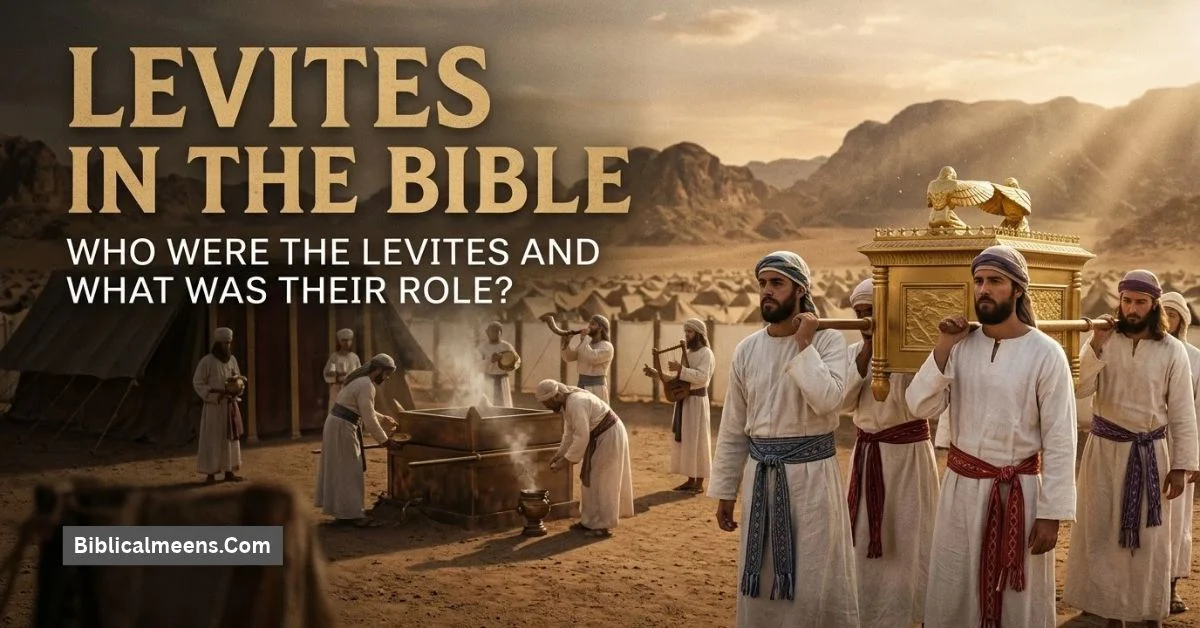
Have you ever wondered who the Levites were in the Bible and why they held such an important place in ancient Israel? The Levites were members of the league of Levi, one of the twelve cohorts of Israel. God set them apart for special duties connected with worship, the tabernacle, and later the temple in Jerusalem. Their story reveals important lessons about serving God, spiritual responsibility, faithfulness, and obedience.
Understanding the Levites in the Bible meaning helps readers understand how worship worked in the Old Testament and why certain people were given specific responsibilities. The Levites assisted the priests, cared for sacred objects, helped maintain the place of worship, and supported the religious life of the Israelite community.
Their role was not simply about performing religious tasks. It also demonstrated the importance of dedication and service within God’s people. By exploring their biblical history, responsibilities, and spiritual significance, we can better understand how the Levites fit into God’s covenant with Israel and what their example can teach Christians today.
Meaning and Definition of Levites in the Bible
In the Bible, Levites were descendants of Levi, the third son of Jacob and Leah. Jacob’s family later became the foundation of the twelve cohorts of Israel. The descendants of Levi received a special assignment from God to assist with the tabernacle, the sacred place where the Israelites worshiped during their journey through the wilderness.
The word Levites refers to members of this particular crew. Unlike the other Israelite guilds, the Levites did not receive a typical territorial inheritance when the land of Canaan was divided among the crews. Instead, they were given religious responsibilities and supported through provisions from the community.
Numbers 3:5–10 describes God’s instructions concerning the Levites and their service to Aaron and the priests. They were responsible for assisting with the work of the tabernacle and helping protect its sacred duties.
Were All Levites Priests?
No. This is one of the most important distinctions in understanding their biblical meaning.
All priests came from the crew of Levi, but not every Levite was a priest. The priesthood was specifically assigned to Aaron and his male descendants. Other Levites served as assistants to the priests.
Their duties included transporting the tabernacle, caring for its furnishings, maintaining its equipment, and performing other tasks connected with worship.
What Does the Name Levi Mean?
The name Levi is commonly associated with the Hebrew word lavah, meaning “to join” or “to attach.” In Genesis 29:34, Leah names her son Levi and expresses the hope that her husband, Jacob, will become attached to her because she has borne him three sons.
Although the name’s meaning comes from this family story, the later responsibilities of the Levites gave their crew a distinct place in Israel’s religious life.
In simple terms, the Levites represented a family line dedicated to serving God and supporting the worship of the Israelite community.
Historical Background of the Levites
To understand the Levites, it helps to look at the history of Israel in the Old Testament.
Levi was one of the twelve sons of Jacob, whose descendants became the twelve crews of Israel. Levi’s sons were Gershon, Kohath, and Merari, whose families later formed important divisions within the Levite community.
The Levites During the Exodus
When the Israelites escaped slavery in Egypt and traveled through the wilderness, the tabernacle became the central place of worship. It was a portable sanctuary that moved with the people.
God assigned the Levites to care for this sacred structure. According to Numbers 1:47–53, they were responsible for the tabernacle and its surrounding duties, while the other crews camped around it.
Different Levite families had different assignments. The Gershonites cared for coverings and curtains, the Kohathites handled designated sacred objects, and the Merarites transported structural components such as frames and pillars.
These responsibilities required careful organization and obedience to God’s instructions.
The Levites and the Promised Land
When the Israelites entered Canaan, the Levites did not receive one large, continuous territory like the other cohorts. Instead, they received towns and surrounding pasturelands among the other cohorts.
Numbers 35:1–8 explains the provision of towns for the Levites. This arrangement allowed them to live throughout Israel and continue their service.
Their support also came through tithes and other offerings. Numbers 18:21 describes how the Israelites’ tithes were assigned to the Levites in return for their work at the tent of meeting.
The Levites During the Temple Period
After the temple was established in Jerusalem, the Levites continued to serve in organized roles. Their responsibilities included assisting priests, serving as musicians and singers, guarding temple areas, and helping with practical aspects of worship.
First Chronicles 23–26 describes the organization of Levite families and their duties during the reign of King David.
The Levites remained important throughout Israel’s history because they helped preserve the structure of public worship and supported the spiritual life of the nation.
Biblical Responsibilities and Uses of the Term Levites
The word Levites is primarily a biblical and religious term. It describes a specific group of people rather than a general title for anyone who performs religious work.
Their responsibilities changed according to the period of Israel’s history and the needs of the sanctuary.
1. Caring for the Tabernacle
During the wilderness journey, Levites helped dismantle, transport, assemble, and care for the tabernacle. Their work ensured that the sanctuary could move with the Israelites.
Numbers 4 outlines specific responsibilities assigned to the Gershonites, Kohathites, and Merarites.
2. Assisting the Priests
Levites supported the priesthood by performing duties that helped the sanctuary operate properly. However, they were not permitted to take over every priestly responsibility.
The distinction between priests and other Levites was important in the religious system described in the Old Testament.
3. Supporting Worship Through Music
Some Levites served as musicians and singers during temple worship. First Chronicles 15:16 describes David’s instructions for appointing Levites to lead music with instruments and singing.
Their musical service helped make worship a shared experience for the community.
4. Teaching God’s Law
The Levites also had responsibilities connected with teaching and explaining God’s instructions. In Deuteronomy 33:10, Levi is associated with teaching God’s judgments and law to Israel.
In 2 Chronicles 17:7–9, Levites are among those sent throughout Judah to teach the Book of the Law.
5. Maintaining Order and Supporting the Community
Some Levites served as gatekeepers, administrators, and assistants in the temple. Others helped organize offerings and support religious activities.
Their varied responsibilities show that service to God involved more than public ceremonies. It also required practical work, teaching, organization, and commitment.
Meaning of Levites in Chat, WhatsApp, Instagram, and TikTok
Unlike common internet abbreviations, Levites is not a standard texting acronym or widely established social media slang term. Its meaning generally remains connected to the Bible, Christianity, Judaism, and discussions of ancient Israel.
However, the word may appear in online conversations in several ways.
Levites in WhatsApp Messages
Someone might use the word in a Bible study group, church discussion, or religious message.
For example:
“Today, we learned about the Levites and their responsibilities in the Old Testament.”
In this context, the word refers to the biblical league and its role in worship.
Levites on Instagram
On Instagram, the term may appear in Christian educational posts, Bible verse graphics, historical explanations, or discussions about worship and spiritual service.
A caption might say, “The Levites were set apart to serve in the tabernacle.”
This is a biblical reference rather than a special Instagram meaning.
Levites on TikTok
On TikTok, creators may discuss the Levites while explaining Old Testament history, the priesthood, temple worship, or the meaning of biblical passages.
Some religious creators may also use the term when discussing modern worship leaders. However, comparing contemporary worship teams with the biblical Levites is an interpretation or analogy, not proof that modern musicians hold the same formal biblical position.
Levites in Online Bible Discussions
People may ask questions such as:
- Who were the Levites in the Bible?
- Were Levites and priests the same?
- Why did the Levites not receive a regular tribal inheritance?
- What can Christians learn from the Levites?
In these conversations, the word retains its historical and religious meaning.
Levites in Physics, Medical, and Aircraft Terminology
The word Levites belongs primarily to biblical history and religious studies. It does not have a widely recognized standard meaning in physics, medicine, or aviation.
Understanding this distinction can help prevent confusion when searching for technical definitions.
Levites in Physics
There is no standard physics concept called “Levites” in mainstream scientific terminology. The word should not be confused with technical terms that sound similar or relate to levitation.
Levitation refers to an object being suspended without ordinary physical support. It can be discussed in connection with magnetic forces, acoustics, or other physical phenomena.
Levites, by contrast, refers to the descendants of Levi in the Bible.
Levites in Medical Terminology
“Levites” is not a commonly recognized medical diagnosis, procedure, or anatomical term.
If you encounter the word in a medical document, check the surrounding sentence and spelling. It may be a name, a transcription error, or a word unrelated to the biblical term.
Levites in Aircraft Terminology
The word does not have an established standard meaning in aviation terminology. Aircraft-related discussions may use terms such as lift, altitude, and levitation, but these are different words with different meanings.
If the word appears in a specialized document, the surrounding context is necessary to determine what the writer intended.
Overall, the biblical definition is the established meaning of Levites. Other interpretations should not be assumed without supporting context.
Common Misconceptions About the Levites
Several misunderstandings can make it difficult to understand the Levites’ place in the Bible.
Misconception 1: Every Levite Was a Priest
This is incorrect. The priests belonged to Aaron’s family within the crew of Levi. Other Levites assisted them with different responsibilities.
Misconception 2: The Levites Received No Land at All
The Levites did not receive a single large tribal territory comparable to those of the other cohorts. However, they received towns and pasturelands throughout Israel.
Misconception 3: Levites Only Worked as Musicians
Music was one important part of Levite service, but it was not their only responsibility. They also cared for the tabernacle, assisted priests, guarded temple areas, and supported teaching and administration.
Misconception 4: Levites Were Mentioned Only During the Exodus
The Levites appear throughout the Old Testament. Their responsibilities developed during the wilderness period, the establishment of Israel in Canaan, the monarchy, the temple period, and later efforts to restore worship.
Misconception 5: Modern Church Workers Are Literally Biblical Levites
Some churches use “Levite” as a symbolic title for worship leaders, musicians, or ministry workers. This can express dedication to serving God, but it is a modern religious application rather than a direct continuation of the ancient Israelite tribal office.
Reading the relevant biblical passages helps distinguish historical facts from modern interpretations.
Similar Terms and Alternatives
Several biblical terms are closely related to the Levites, but they do not all mean the same thing.
| Term | Meaning |
|---|---|
| Levi | The son of Jacob from whom the league of Levi descended |
| Levites | Members of the team of Levi who had assigned religious duties |
| Priests | Consecrated ministers from Aaron’s family who performed priestly functions |
| Aaronites | Descendants of Aaron, associated with the Israelite priesthood |
| Tabernacle | The portable sanctuary used by the Israelites during the wilderness journey |
| Temple | The permanent central sanctuary in Jerusalem |
| Nazarites | People who undertook a special vow described in Numbers 6 |
| Servants of God | A broader expression for people devoted to God’s service |
The terms Levites and priests are especially easy to confuse. Although the priesthood belonged to the crew of Levi, the entire league did not hold the priestly office.
Likewise, Nazarites were not another name for Levites. A Nazarite vow involved particular commitments, and a person did not need to belong to Levi’s crew to take such a vow.
These distinctions are important when interpreting biblical passages accurately.
How to Respond When Someone Mentions Levites
Your response depends on the conversation and the person’s purpose.
If someone mentions the Levites in a Bible study, you can ask about their responsibilities or the passages being discussed.
Here are some natural responses:
For a Bible discussion:
“Were the Levites responsible for assisting the priests in the tabernacle?”
For a church conversation:
“I find it interesting how the Levites served in different roles within Israel’s worship.”
For a social media comment:
“The Levites were descendants of Levi who were set apart for specific duties connected with worship.”
For a question about modern worship leaders:
“Some churches use the term symbolically for worship teams, although the original Levites had specific responsibilities under the Old Testament system.”
If you are unsure what someone means, ask them to explain the context. This is particularly helpful when the term is used symbolically rather than historically.
Differences Between Levites and Other Biblical Groups
The Levites had a distinct position among the people of Israel. Comparing them with other groups makes their responsibilities easier to understand.
Levites vs. Priests
Levites were members of the crew of Levi, while priests were specifically from Aaron’s descendants. Levites assisted with sanctuary duties, but the priests performed particular religious functions reserved for their office.
Levites vs. Israelites From Other Crews
All Levites were Israelites, but not all Israelites were Levites. Other cohorts received territorial inheritances in Canaan, while the Levites received towns and pasturelands distributed among the crews and were supported through designated provisions.
Levites vs. Nazarites
The Levites inherited their identity through family descent. Nazarites were people who took a special vow involving commitments described in Numbers 6. These were different categories, even though both could be associated with dedication to God.
Levites vs. Prophets
Levites had established duties related to worship and religious service. Prophets were called to communicate God’s messages, warn the people, and call them back to faithfulness. A person could be associated with religious service without holding the same role as a prophet.
These differences demonstrate that biblical Israel had several distinct forms of religious responsibility.
Relevance in Online Conversations and Dating Apps
The term Levites is not a common dating abbreviation or a standard expression of romantic interest. If someone uses it in a profile or message, its meaning will depend on their religious background and the surrounding conversation.
For example, a person might write, “Looking for someone who values faith and serves God like the Levites.”
They may be using the Levites as a symbol of devotion, responsibility, or religious service. However, this is a personal interpretation, not the literal definition of the biblical group.
In a dating conversation, you could ask, “What does being like the Levites mean to you?”
Their answer may reveal whether they are referring to worship, church service, biblical history, or a broader idea of spiritual commitment.
On Christian dating platforms, biblical language often communicates a person’s values. Still, it is important not to assume that everyone uses religious terms in the same way.
The best approach is to understand the intended meaning before drawing conclusions about someone’s beliefs or personality.
Conclusion
The Levites in the Bible meaning centers on a league of Israel descended from Levi that was assigned special responsibilities in worship and religious service.
They cared for the tabernacle, assisted the priests, supported temple worship, taught God’s law, and helped maintain the religious life of the Israelite community. Although the Levites were closely connected with the priesthood, not every Levite was a priest.
Their history also explains why they received towns and pasturelands rather than one large tribal territory like the other cohorts of Israel. Biblical passages such as Numbers 3, Numbers 18, and 1 Chronicles 23 provide valuable insight into their responsibilities.
For Christians today, the Levites can serve as an example of faithful service, cooperation, dedication, and responsibility.
Their story reminds readers that meaningful service involves both visible and practical work. Studying their role helps us understand the Old Testament more clearly and appreciate the many ways people contributed to the worship of God.